USAID DEC
Data Meeting: Identifying Work/Partnership Mechanism in Data Use and Analysis of Fish Landing Data
Sign inTETRA TECH
Data Meeting: Identifying Work/Partnership Mechanism in Data Use and Analysis of Fish Landing Data
Fisheries management in Indonesia is a critical component of the country's economic and food security.
2018 · 19 pages
Sign in to readA free account is required to download.
Abstract
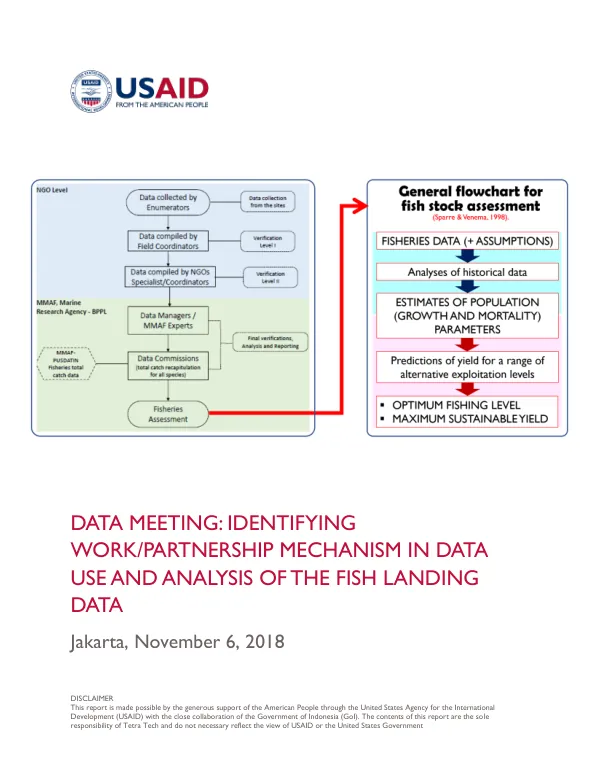
The Fishery Law No. 31 of 2004 emphasizes the importance of integrated efforts in collecting information, planning, consultation, and enforcement of laws and regulations to achieve sustainable productivity of fishery resources. The Indonesian government has established 11 Fisheries Management Areas (FMA) and issued Fisheries Management Plans (FMP) for 715 FMA, with demersal and big-pelagic fisheries being priorities. The USAID Sustainable Ecosystem Advanced (SEA) Project provides support to strengthen Indonesian fisheries, including harvest strategy development for targeted species. The project has conducted various activities, including data collection management workshops and trainings, and has submitted fish landing data to the Indonesian Ministry of Marine Affairs and Maritime Affairs (MMAF) through the BRPL database. However, there is a need to establish a work/partnership mechanism between USAID-SEA partners and MMAF to ensure data use and analysis, protect intellectual properties, and clarify the scope of NOAA stock assessment experts' support. The meeting held on November 6, 2018, aimed to identify work mechanisms for analyzing fish landing monitoring data, roles for each party, and the scope of NOAA stock assessment experts' support. The objectives of the meeting were to: 1. Identify work mechanisms for analyzing fish landing monitoring data and roles for each party. 2. Identify the scope of NOAA stock assessment experts' support for data analysis and development of harvest strategy. 3. Clarify the e-BRPL system and update on its implementation. The meeting was attended by researchers from MMAF, USAID SEA partners (WCS and WWF), and other stakeholders. The key outputs, outcomes, and achievements of the meeting include: 1. The importance of robust and timely data for supporting national policies and providing advice to the government and industry. 2. The establishment of the e-BRPL database for national data collection and analysis. 3. The need for understanding the coverage of data collected by NGOs and the importance of estimating total catch and representativeness of sampling. 4. The value of fishing data from fishing master and one-data system in supplementing fishing landing data. 5. The proposal for capacity building for MMAF researchers with NOAA experts in data analysis, data analysis methodology, and stock synthesis, with a focus on skill transfer and skill transfer in data analysis. The proposed agenda for capacity building with NOAA includes: 1. Data Limited Method tool: Total Allowable Catch and harvest strategy by fishery/gear. 2. Stock synthesis in data situation and in data rich situation. 3. CPUE standardization (hand, gillnet, purse seine), concept, and exercise. Recommendations from the meeting include: 1. Data collected by USAID SEA partners needs to be verified and validated before integration. 2. Each USAID SEA partner should assign a person in charge for data verification and clarification. 3. The data flow mechanism agreed upon in February 2018 should be implemented at the NGO level. 4. The data collected should be shared with local government in a descriptive statistic format, with caution and thoroughness. 5. NGOs should take the lead in descriptive analysis, and findings should be reviewed by BRPL for quality control prior to dissemination at the provincial level.
Related documents