DEUTSCHE GESELLSCHAFT FÜR INTERNATIONALE ZUSAMMENARBEIT GMBH
Ghana Customs Risk Management Rapid Assessment
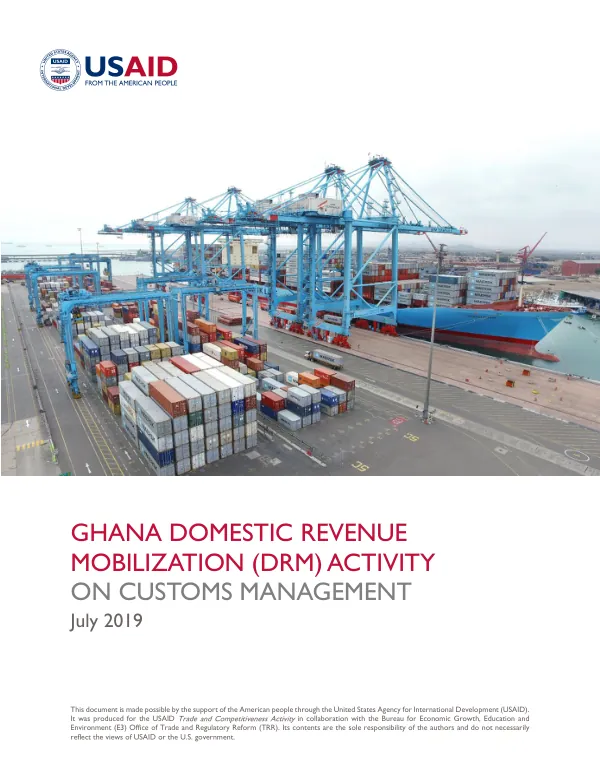
The Ghana Revenue Authority (GRA) Customs Division has prioritized adherence to Article 7 of the World Trade Organization's Trade Facilitation Agreement (WTO TFA), which focuses on the release and clearance of goods, including Article 7.4, Risk Management (RM).
2018 · 46 pages
Sign in to readA free account is required to download.
Abstract
The Trade Africa: Trade Facilitation Project (TATFP) has been actively engaged with the GRA Customs Division since November 2017, providing technical assistance and support to enhance customs procedures and address technical assistance needs. The current risk assessment process in Ghana targets 72 commodities at the pre-arrival processing stage, using the Pre-Arrival Assessment Reporting System (PAARS), a GRA Customs tool developed and hosted by West Blue Consulting Ltd. However, this system weights risk factors without considering additional risk indicators, such as the importer, clearing agent/broker used, country of origin, etc. This results in compliant traders being treated no differently from non-compliant traders. The GRA Customs RM functions should be re-organized inside a dedicated RM Unit within the GRA Customs division. Currently, one Customs officer reports directly to the GRA Commissioner General, but is unsure of their role and relationship with other Customs functions. Three officers are involved in RM at the pre-arrival stage, but their responsibilities and focus areas are unclear. Effective RM requires a clear RM policy and framework, a risk treatment strategy, and standard operating procedures that are clearly articulated and communicated. TATFP recommends the following: Re-organize and consolidate GRA-Customs RM functions under a dedicated unit reporting to the GRA Customs Commissioner with strong linkage to intelligence and investigations. Create RM Standard Operating Procedures. Train GRA Customs and relevant stakeholders on RM, including improving risk profiling and the holistic risk assessment process. Develop a clear RM framework, policy, and strategy. Approve a position description specific to risk analysts or to officers assigned to the GRA Customs RM Unit. Recruit and train GRA Customs risk analysts. Communicate RM throughout GRA-Customs. GRA Customs should form a high-level RM Steering Committee responsible for developing an organizational RM philosophy with the support of senior management. The current RM process in Ghana is not in full alignment with the specifications of the World Customs Organization (WCO) and the requirements of Article 7.4 of the WTO TFA. The overlapping processes of pre-arrival and upon-arrival document review apply to every importation undergoing Yellow Channel (document review) control. Currently, 76 percent of declarations are routed for physical examination, with less than 2 percent resulting in reported findings of non-compliance. Scanning is considered a type of physical examination and almost 100 percent of declarations are routed to be scanned. The GRA Customs RM Unit should be responsible for performing risk assessment for customs cargo selectivity, which is different from revenue leakage risk for domestic tax. The RM Unit should be under the control of the GRA Customs Commissioner and should have a clear RM policy and framework, a risk treatment strategy, and standard operating procedures.