USAID
Empowering Women in the Cocoa Sector in Ghana: Gender Assessment Brief
The agricultural development initiative in Ghana focuses on empowering women in the cocoa sector.
2021 · 6 pages
Sign in to readA free account is required to download.
Abstract
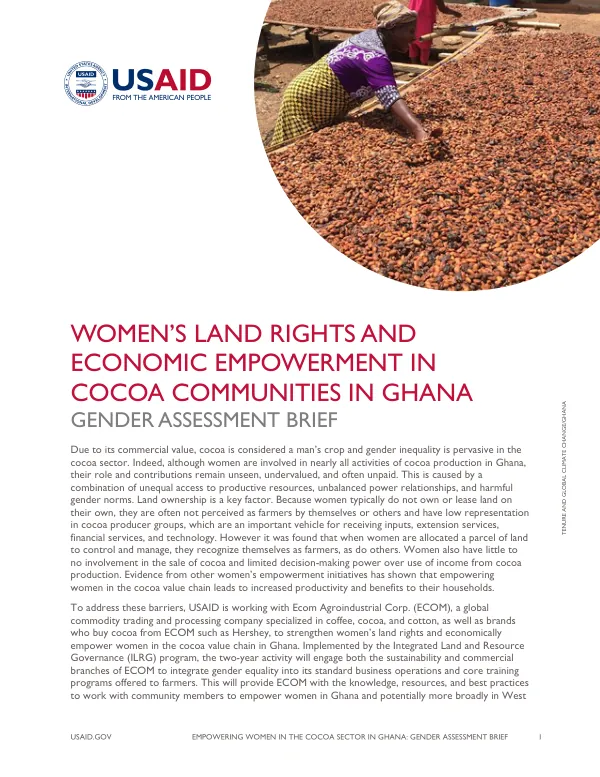
The country's commercial value of cocoa is considered a man's crop, and women's roles and contributions remain unseen, undervalued, and often unpaid. Women typically do not own or lease land on their own, which prevents them from being perceived as farmers and limits their representation in cocoa producer groups. Land ownership is a key factor in women's empowerment in the cocoa sector. When women are allocated a parcel of land to control and manage, they recognize themselves as farmers, as do others. Women also have little to no involvement in the sale of cocoa and limited decision-making power over the use of income from cocoa production. Empowering women in the cocoa value chain leads to increased productivity and benefits to their households. The Integrated Land and Resource Governance (ILRG) program, implemented by USAID, is working with Ecom Agroindustrial Corp. (ECOM) to strengthen women's land rights and economically empower women in the cocoa value chain in Ghana. ECOM is a global commodity trading and processing company that specializes in coffee, cocoa, and cotton. The company is finalizing a framework of sustainability commitments that include gender equality, providing momentum for the proposed activity. The gender assessment found that ECOM has promoted gender equality within the company and in its work with cocoa farmers in Ghana, although clear policies, strategies, and expertise to guide such efforts remain a critical gap. Women's representation in field positions remains very low, and women have less direct access to inputs and lower participation in training. The company signs contracts with individual farmers based on their status as land owners, which means most contracts are signed with men. Social norms establish that it is a sign of respect for women to have men leading the sale of cocoa, and most women think it is not their place to sell cocoa beans. Gender-based violence (GBV) can happen at any time, particularly in scenarios where the distribution of power is disrupted. Acceptance of GBV, particularly intimate partner violence, was noted in the districts consulted. Men and women farmers agreed that a man has the right to punish his wife if she disrespects or disobeys him. The division of labor in the cocoa value chain is highly gendered, with most tasks completed by both men and women. Socially defined gender roles reserve for men activities that are considered physically strenuous, require expert knowledge, and have a high decision-making value. Women are mostly responsible for planting and harvesting food crops, and they use small trading and soap making as a source of additional income. Women's time poverty is high, and they have less availability to work in cocoa farming, attend training, and engage in income diversification activities.