AFRICARE, INC.
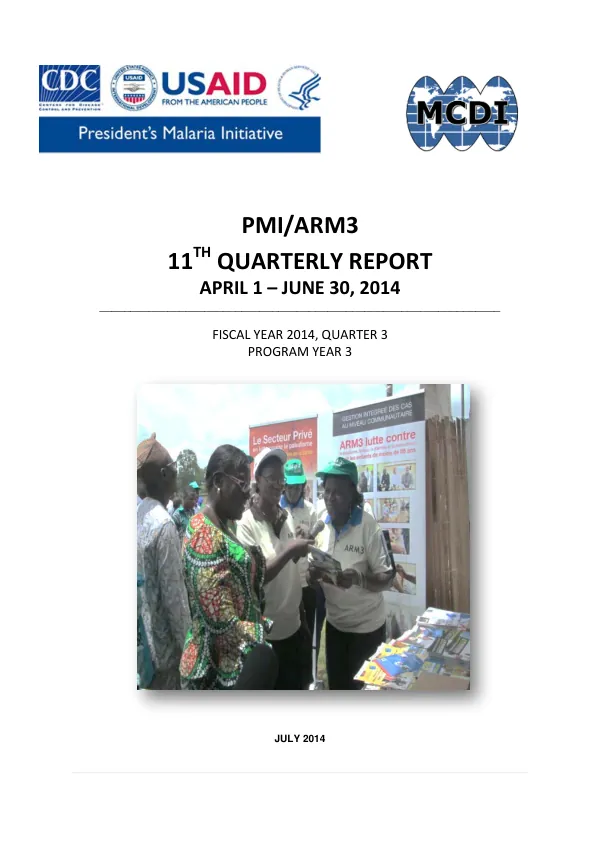
11th Quarterly Report: April 1, 2014 to June 30, 2014
The Accelerating the Reduction of Malaria Morbidity and Mortality Program (ARM3) is a program funded by the United States Agency for International Development (USAID) under Cooperative Agreement AID-680-A-11-00001.
2014 · 50 pages
Sign in to readA free account is required to download.
Abstract
ARM3 is managed by Medical Care Development International (MCDI) as the prime, in collaboration with sub-grantees Africare, Johns Hopkins University – Center for Communications Program (JHU-CCP), and Management Sciences for Health (MSH). The program aims to accelerate the reduction of malaria morbidity and mortality in Benin. Implementation of malaria prevention programs in support of the National Malaria Strategy Improved. Intermittent Preventive Treatment for Pregnant Women (IPTp) uptake increased, with a 25% increase in the number of pregnant women receiving IPTp compared to the previous quarter. Supply and use of Long Lasting Insecticide-Treated Nets (LLINs) also increased, with a 30% increase in the number of LLINs distributed compared to the previous quarter. Malaria diagnosis and treatment activities in support of the National Malaria Strategy Improved. Diagnostic capacity and use of testing improved, with a 20% increase in the number of malaria tests conducted compared to the previous quarter. Case management of uncomplicated and severe malaria improved, with a 15% increase in the number of patients treated for uncomplicated malaria and a 10% increase in the number of patients treated for severe malaria. The Performance Improvement Approach (PI) was implemented in participating Health Zones (HZs) and hospitals, resulting in improved clinical management of malaria cases. The National Health System's capacity to deliver and manage quality malaria treatment and control interventions was strengthened. The National Malaria Control Program's (NMCP) technical capacity to plan, design, manage, and coordinate a comprehensive malaria control program was enhanced, with a 25% increase in the number of NMCP staff trained in malaria control and management. Capacity to collect, manage, and use malaria health information for Monitoring and Evaluation (M&E) and surveillance improved, with a 20% increase in the number of malaria cases reported compared to the previous quarter. Capacity in commodities and supply chain management improved, with a 15% increase in the number of malaria commodities distributed compared to the previous quarter. Cross-sectional activities were also implemented, including outreach training support and supervision (OTSS) and quality improvement teams (QIT). The OTSS program provided training and support to health workers in 10 Health Zones, resulting in improved malaria case management and treatment. The QIT program implemented quality improvement initiatives in 5 Health Zones, resulting in improved malaria diagnosis and treatment. Major challenges faced by the program included supply chain management issues, resulting in delays in the distribution of malaria commodities. However, the program implemented a number of strategies to address these challenges, including the implementation of a new logistics management information system (LMIS) and the establishment of a commodities management program (MEDISTOCK). The program also faced challenges in terms of funding, with a 10% reduction in funding compared to the previous quarter. However, the program was able to implement a number of cost-saving measures, including the reduction of travel costs and the implementation of a new financial management system. Overall, the ARM3 program made significant progress in the reduction of malaria morbidity and mortality in Benin during the 11th quarter of the program. The program's implementation of malaria prevention programs, diagnosis and treatment activities, and cross-sectional activities resulted in improved malaria case management and treatment, and strengthened the National Health System's capacity to deliver and manage quality malaria treatment and control interventions.
Related documents