USAID DEC
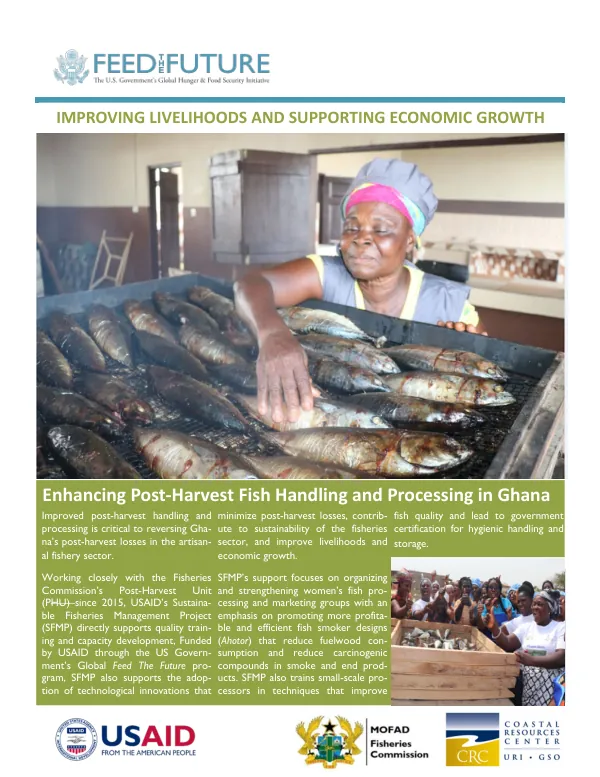
Improving Livelihoods and Supporting Economic Growth: Supporting Hygienic Fish Processing in Ghana
Sign inCOASTAL RESOURCES CENTER OF THE UNIVERSITY OF RHODE ISLAND
Improving Livelihoods and Supporting Economic Growth: Supporting Hygienic Fish Processing in Ghana
Improving Livelihoods and Supporting Economic Growth in Ghana's Artisanal Fishery Sector The artisanal fishery sector in Ghana faces significant post-harvest losses, resulting in a substantial decline in the quality and quantity of fish products.
2019 · 2 pages
Sign in to readA free account is required to download.
Abstract
To address this challenge, the USAID's Sustainable Fisheries Management Project (SFMP) has been working closely with the Fisheries Commission's Post-Harvest Unit (PHU) since 2015. Funded by the US Government's Global Feed The Future program, SFMP supports quality training and capacity development, as well as the adoption of technological innovations that minimize post-harvest losses and contribute to the sustainability of the fisheries sector. SFMP's support focuses on organizing and strengthening women's fish processing and marketing groups, with an emphasis on promoting more profitable and efficient fish smoker designs, such as the Ahotor oven. This innovative technology reduces fuelwood consumption and carcinogenic compounds in smoke and end products, resulting in healthier and higher-quality smoked fish. The Ahotor oven is 31.8% more energy efficient than traditional Chorkor smokers, emits less carbon dioxide, and produces a product with a more attractive golden-brown hue, a less-smoky taste, reduced moisture content, and shorter smoking time. To support national government objectives in improving hygienic fish processing and enhancing the business practices and earnings of women processors, SFMP introduced the Ahotor oven to 29 fishing communities across the four coastal regions. A total of 141 new Ahotor ovens were built in partnership with the Ministry of Fisheries and Aquaculture Development, the Fisheries Commission, the Food Research Institute, the Institute of Industrial Research, and the Netherlands Development Organization. Additionally, SFMP established Fish Processing and Training Facilities in the Central and Greater Accra regions to ensure training and extension efforts are accessible to communities. SFMP has also improved the capacity of more than 4,237 fish processors in hygienic fish handling, processing techniques, hygienic packaging, fire safety, small business financial management, value addition opportunities, record keeping, and improved processing technologies like the Ahotor oven. The trainings are combined with small business skills training for the women processors, most of whom have little or no formal education. Furthermore, SFMP has strengthened the capacity of fish processor groups and institutions, including the Development Action Association and the Central and Western Fish Mongers Association, to drive their own programs and expand their services to government and communities across Ghana. To promote healthy fish and support the development of a certification scheme for hygienic fish processing, SFMP has worked with the Fisheries Commission and the Ghana Standard Authority to develop a Class 1 Certification scheme. This scheme requires fish processors to meet minimum standards in their processing work to be certified as Class I hygienic fish processors. A total of 165 selected fish processors from the four coastal regions have been trained in 2018 and are currently undergoing the practical application process required for their certification. SFMP has also promoted healthy fish educational campaigns across the four coastal regions, reaching a wide audience through various media channels. The Feed the Future program, which supports partner countries in developing their agriculture, fisheries, and other food-related sectors, has been instrumental in supporting SFMP's efforts in Ghana. With a focus on smallholder agricultural and fisheries activities, especially those implemented by women, the program aims to spur economic growth and trade that increases incomes and reduces hunger, poverty, and malnutrition.