ADVENTIST DEVELOPMENT AND RELIEF AGENCY INTERNATIONAL
Ghana WASH Project – Year 4 Annual Report
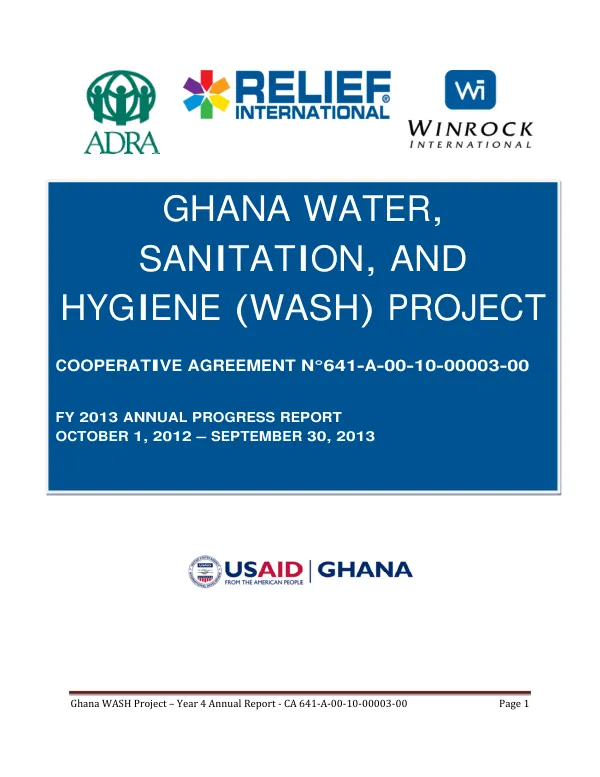
The Ghana WASH Project, implemented by Relief International in partnership with Winrock International and the Adventist Development and Relief Agency (ADRA), aims to improve access to safe and adequate water supply and basic sanitation facilities infrastructure for households, clinics, and schools, and promote complementary hygiene practices.
2013 · 52 pages
Sign in to readA free account is required to download.
Abstract
The project covers underserved populations in Ghana in five regions: Central, Eastern, Greater Accra, Volta, and Western. The project has five key objectives: to increase access to improved water and sanitation infrastructure, assist in developing innovative modes of establishing new infrastructure, improve the capacity of small grant recipients, support the development of behaviors that result in well-utilized WatSan infrastructure and increased adoption of complementary hygiene behaviors, and manage existing partnerships and develop new partnerships with private sector and/or voluntary organizations. During FY2013, the project made significant progress in achieving its objectives. Innovations in the rural water sector, including manual drilling and borehole repairs, were implemented, resulting in improved access to safe drinking water for rural communities. Community-Led Total Sanitation (CLTS) activities and household latrine building were also conducted, with a focus on promoting open defecation-free (ODF) communities. The project also expanded its impacts through the Small Grants Facility, which provided funding to local organizations to implement WASH-related projects. Public-Private Partnerships (PPPs) were established with private sector partners, including The Coca-Cola Company, to support the project's objectives. Additionally, the project collaborated with other USAID strategic partners, including Rotary International and WaterHealth International, to leverage resources and expertise. The project faced several challenges during the reporting period, including delays in household latrine facility construction, complications associated with the Coca-Cola WADA partnership, and issues with manual drilled boreholes and borehole repairs. However, the project was able to adapt and overcome these challenges, and made significant progress in achieving its objectives. The project's progress towards achieving its objectives and targets is reflected in the Performance Management Plan (PMP) indicator table, which is included in the annual report as an appendix. The PMP update reflects the project's revised objectives and targets, and provides a framework for measuring progress and evaluating the project's impact. The Ghana WASH Project has made significant contributions to achieving USAID/Ghana's health sector Strategic Objective 7 (SO7) and Intermediate Results 4 (IR4). The project's success is a testament to the power of collaboration and partnership in achieving development goals, and demonstrates the importance of investing in WASH infrastructure and promoting complementary hygiene behaviors to improve public health.
Related documents