TETRA TECH
USAID/WEST AFRICA MUNICIPAL WASH: PLAN DE TRAVAIL ANNUEL INITIAL (EXERCICE 2020)
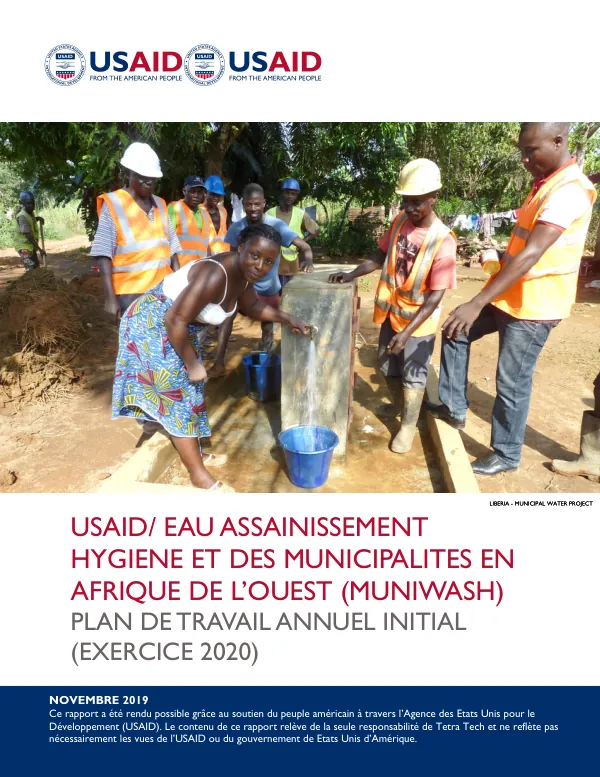
The USAID/West Africa Municipal Water, Sanitation, and Hygiene (MuniWaSH) project aims to improve water, sanitation, and hygiene services in West Africa.
2020 · 44 pages
Sign in to readA free account is required to download.
Abstract
The project focuses on four main domains of service: durability of financial resources and private sector investments, operational reliability, governance and management at the municipal level, and learning and knowledge sharing at the regional level. The project's initial work plan for 2020 outlines several key tasks and activities. In the domain of durability of financial resources and private sector investments, the project aims to evaluate the financial performance and economic models of water and sanitation service providers, strengthen the capacity of these providers, and improve financial planning and control. The project also seeks to increase access to financial products for these providers. In the domain of operational reliability, the project aims to conduct market research and studies on customer satisfaction, improve operational processes of service providers, extend and diversify services for the poor, and improve the operational environment of water and sanitation service providers. The project also focuses on governance and management at the municipal level, with tasks such as implementing the Institutional Strengthening Index (ISI) within the project framework, strengthening the capacity of municipalities in planning and budgeting, facilitating collaboration between the central administration and municipalities, and improving the capacity of municipalities to provide services. In the domain of learning and knowledge sharing at the regional level, the project aims to establish a learning program and communities of practitioners, collect and document lessons learned, document and disseminate investment opportunities, develop and implement an effective communication and awareness strategy, and offer formal learning opportunities. The project's calendar and key events are outlined in Chapter 3, and the project's risks and mitigation measures are discussed in Chapter 4. The project's personnel, management, and administration are outlined in Chapter 6. The project's annexes include a calendar of activities from September 2019 to September 2020 and a summary of FY20 contract deliverables. The project's acronyms and abbreviations are listed in the appendix. The project's overall goal is to improve water, sanitation, and hygiene services in West Africa, with a focus on durability of financial resources and private sector investments, operational reliability, governance and management at the municipal level, and learning and knowledge sharing at the regional level. The project's implementation will be carried out in several West African countries, with a focus on improving the capacity of municipalities to provide water, sanitation, and hygiene services. The project will also work to strengthen the capacity of water and sanitation service providers, improve financial planning and control, and increase access to financial products for these providers. The project's learning and knowledge sharing activities will focus on establishing a learning program and communities of practitioners, collecting and documenting lessons learned, and disseminating investment opportunities. The project will also develop and implement an effective communication and awareness strategy to promote the project's goals and objectives. The project's personnel, management, and administration will be responsible for implementing the project's activities and ensuring that the project's goals and objectives are met. The project's calendar and key events will be used to track progress and ensure that the project stays on track. The project's risks and mitigation measures will be discussed in Chapter 4, and the project's annexes will provide additional information on the project's activities and deliverables.