PATH
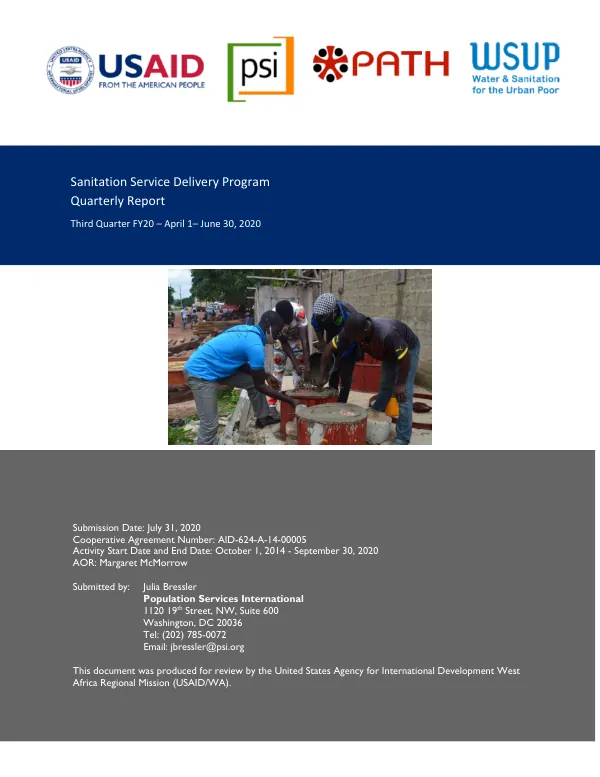
Sanitation Service Delivery Program Annual Report
The Sanitation Service Delivery Program (SSD) is a $17.8 million USAID/West Africa regional urban sanitation initiative that operated in Benin, Côte d'Ivoire, and Ghana from October 2014 to September 2020 with a one-year extension.
2020 · 68 pages
Sign in to readA free account is required to download.
Abstract
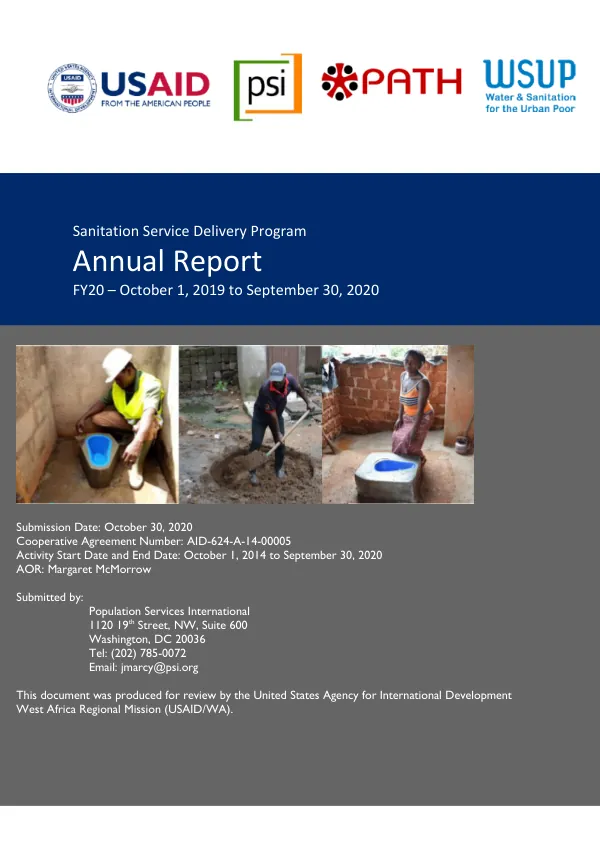
The program aims to create a more effective, efficient, and inclusive sanitation market for the urban poor in Benin and Côte d'Ivoire. The project works toward achieving this goal by developing and testing scalable, market-based models that directly contribute to improving sanitation outcomes. The project's goal is to increase access to improved sanitation, increase safe containment, transport, and disposal of fecal waste, and regional learning to inform market-based approach sanitation programs throughout West Africa. In FY2020, the number of latrine products sold in Benin and Côte d'Ivoire was 20,243, a 500% increase over the average annual sales rate of the previous five years. The project achieved a completion rate of 91.61% of its target of 22,096 toilets sold. The project also focused on improving sanitation service quality, with 274,324 people receiving improved sanitation service quality from an existing "limited" or "basic" service. The project achieved a completion rate of 59.76% of its target of 459,019 people reached. In addition, the project aimed to increase access to basic sanitation, with 127.13% (22,459 people reached out of the 17,666 planned) of the target achieved. The project also focused on fecal sludge management, with 66,463,000 liters of fecal sludge safely removed and transported as a result of U.S. government assistance. This represents a completion rate of 115.17% of the expected 57,708,588 liters. The project also aimed to improve micro-entrepreneurs' employment conditions, with 16 new entrepreneurs obtained since January 2020. All 16 entrepreneurs were active three months later and had installed at least one SaniPlus product. In Côte d'Ivoire, the project continued its activities in supporting the emerging market, strengthening the capacities and skills of various market players, especially private-sector micro-entrepreneurs, increasing support from government institutions, and sharing lessons learned. The project developed sanitation products and services and laid the foundation for a sustainable sanitation market based on the following products: double pit latrines, SaTo pan toilet seats, and soakaway pits. These products are promoted and marketed under the SaniPlus brand. The project faced challenges in disseminating SaniPlus products for social impact, due to micro-entrepreneurs not feeling like they had ownership and some sales agents' actions. However, the project continued its efforts to promote SaniPlus to households, so they adopt these products as solutions to improve their sanitation. The project's extension year will focus on COVID-19 prevention activities during sanitation activities in Benin and Côte d'Ivoire.