USAID DEC
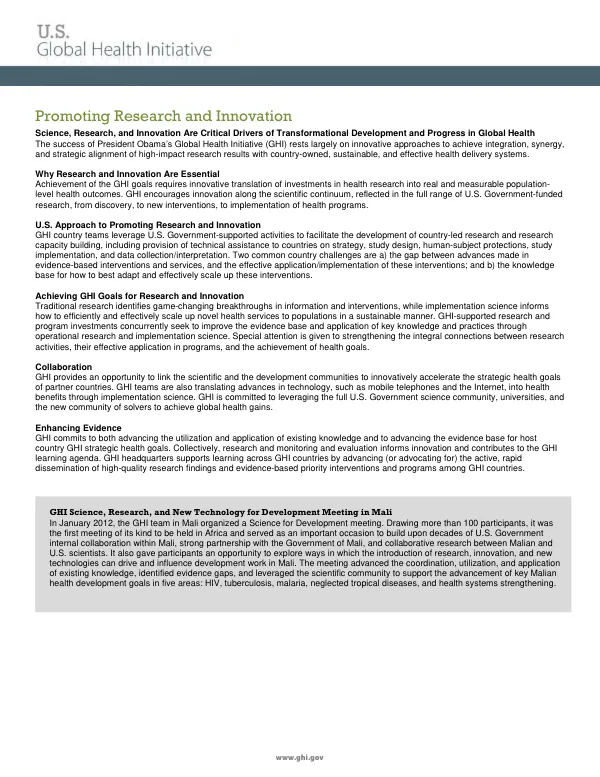
GHI Principles: Promoting Research and Innovation
The Global Health Initiative (GHI) emphasizes the importance of innovative approaches to achieve integration, synergy, and strategic alignment of high-impact research results with country-owned, sustainable, and effective health systems.
2012 · 1 pages
Sign in to readA free account is required to download.
Abstract
The initiative encourages innovation along the scientific continuum, from discovery to implementation of health programs. GHI country teams facilitate the development of country-led research and research capacity building, providing technical assistance on strategy, study design, human-subject protections, study implementation, and data collection/interpretation. A key challenge in many countries is the gap between advances in evidence-based interventions and services, and the effective application and implementation of these interventions. Additionally, there is a need to adapt and scale up interventions in a sustainable manner. To address these challenges, GHI-supported research and program investments focus on operational research and implementation science. This approach seeks to strengthen the connections between research activities, their application in programs, and the achievement of health goals. GHI provides an opportunity for collaboration between the scientific and development communities to accelerate the achievement of global health goals. The initiative leverages advances in technology, such as mobile telephones and the Internet, through implementation science. GHI teams work to accelerate the development of new health technologies and innovations, with a focus on addressing the health needs of partner countries. The GHI also emphasizes the importance of evidence-based decision-making. The initiative commits to advancing the utilization and application of existing knowledge and to advancing the evidence base for host country GHI strategic health goals. Research and monitoring and evaluation inform innovation and contribute to the GHI learning agenda. GHI headquarters supports learning among GHI countries by disseminating high-quality research findings and evidence-based priority interventions and programs. In January 2012, the GHI team in Mali organized a Science for Development meeting, which brought together more than 100 participants from Malian and U.S. scientists. The meeting aimed to advance the coordination, utilization, and application of existing knowledge, identify evidence gaps, and leverage the scientific community to support key Malian health development goals in five areas: tuberculosis, malaria, tuberculosis, malaria, and health systems strengthening. The meeting provided an opportunity for participants to explore ways in which research, innovation, and new technologies can drive and influence development work in Mali.