PRESIDENT'S EMERGENCY PLAN FOR THE U.S. FOR AIDS RELIEF
GHI Target: HIV/AIDS
The U.S.
2012 · 3 pages
Sign in to readA free account is required to download.
Abstract
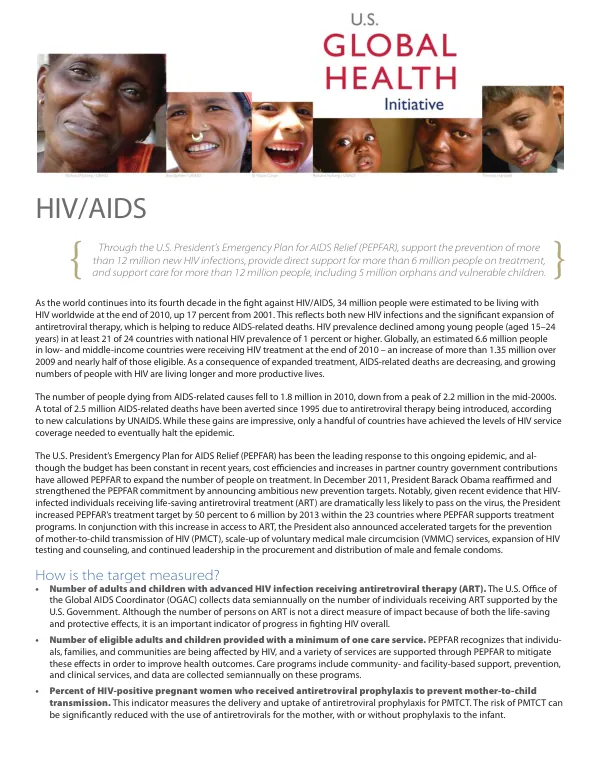
Global Health Initiative's HIV/AIDS program, supported by the President's Emergency Plan for AIDS Relief (PEPFAR), aims to prevent more than 12 million new HIV infections, provide direct support for more than 6 million people on treatment, and support care for more than 12 million people, including 5 million orphans and vulnerable children. As of 2010, an estimated 34 million people were living with HIV worldwide, a 17 percent increase from 2001. This reflects both new HIV infections and the expansion of antiretroviral therapy, which has helped reduce AIDS-related deaths. HIV prevalence declined among young people in at least 21 of 24 countries with national HIV prevalence of 1 percent or higher. Globally, an estimated 6.6 million people in low- and middle-income countries were receiving HIV treatment at the end of 2010, an increase of more than 1.35 million over 2009 and nearly half of those eligible. As a result of expanded treatment, AIDS-related deaths are decreasing, and growing numbers of people with HIV are living longer and more productive lives. The number of people dying from AIDS-related causes fell to 1.8 million in 2010, down from a peak of 2.2 million in the mid-2000s. A total of 2.5 million AIDS-related deaths have been averted since 1995 due to antiretroviral therapy being introduced, according to new calculations by UNAIDS. While these gains are impressive, only a handful of countries have achieved the levels of HIV service coverage needed to eventually halt the epidemic. The U.S. President's Emergency Plan for AIDS Relief (PEPFAR) has been the leading response to this ongoing epidemic. Although the budget has been constant in recent years, cost efficiencies and increases in partner country government contributions have allowed PEPFAR to expand the number of people on treatment. In December 2011, President Barack Obama reaffirmed and strengthened the PEPFAR commitment by announcing ambitious new prevention targets. The target for the number of adults and children with advanced HIV infection receiving antiretroviral therapy (ART) is measured by the U.S. Office of the Global AIDS Coordinator (OGAC), which collects data semiannually on the number of individuals receiving ART supported by the U.S. Government. The number of eligible adults and children provided with a minimum of one care service is also tracked, as well as the percent of HIV-positive pregnant women who received antiretroviral prophylaxis to prevent mother-to-child transmission. PEPFAR programs are implemented in 23 countries, including Angola, Botswana, Burundi, Cameroon, Cote d'Ivoire, Democratic Republic of Congo, Ethiopia, Ghana, Kenya, Lesotho, Malawi, Mozambique, Namibia, Nigeria, Rwanda, South Africa, South Sudan, Swaziland, Tanzania, Uganda, Zambia, and Zimbabwe. As of September 30, 2011, PEPFAR directly supported life-saving antiretroviral treatment for more than 3.9 million men, women, and children worldwide and nearly 13 million people with care and support, including more than 4.1 million orphans and vulnerable children. In addition, proven prevention interventions continue to be scaled up. In FY 2011, 660,000 HIV-positive pregnant women received antiretroviral prophylaxis to prevent mother-to-child transmission, and this number is expected to increase to approximately 820,000 pregnant women by 2013, which equates to 72 percent coverage. VMMC in FY 2011 rose to 574,000, and this figure is estimated to increase to a total of 4,700,000 in 14 targeted countries by 2013.