USAID DEC
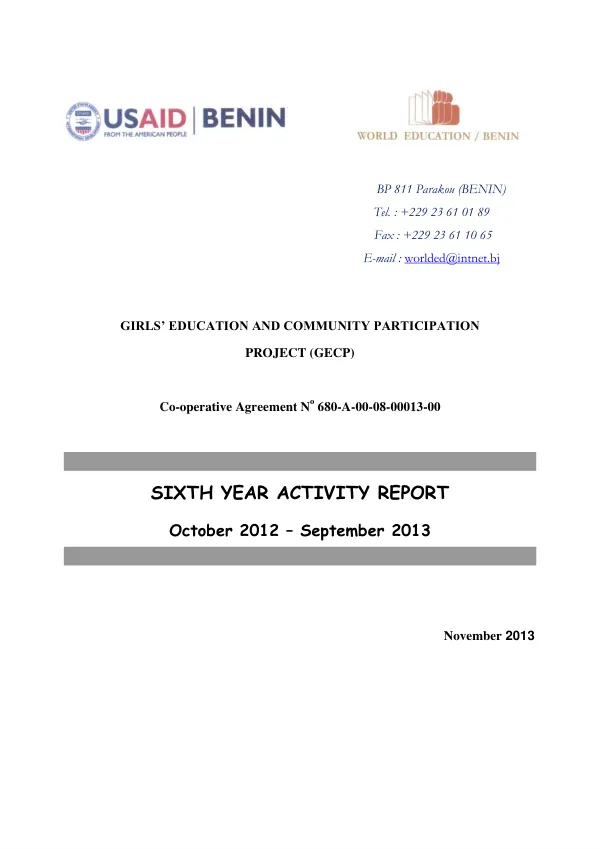
Girls' Education and Community Participation Project (GECP) Sixth Year Activity Report
Sign inUNICEF
Girls' Education and Community Participation Project (GECP) Sixth Year Activity Report
The Girls' Education and Community Participation (GECP) Project in Benin was a six-year initiative that aimed to improve girls' education and community participation.
2013 · 43 pages
Sign in to readA free account is required to download.
Abstract
The project was implemented in various regions, with a focus on rural areas. Community involvement was high, particularly among the Association des Mères d'Elèves (AME), which played a crucial role in promoting girls' education. Radio broadcasts highlighting the importance of girls' education were developed and aired during the sixth year of the project. These broadcasts were organized by the AMEs and listened to by locally organized "listeners' clubs." The AMEs, supported by the Association des Parents d'Elèves (APE), encouraged mothers to share household responsibilities more equitably between boys and girls. This allowed girls to have more time to review lessons and complete homework, just like boys. Before the new school year, the AMEs conducted a detailed survey to determine the number of eligible school-age children and encourage parents to prioritize school attendance. The survey aimed to give children the best chance possible for their future. During the year, parents expressed concerns about the new system of administrative functions being centralized at the district level. This system was seen as a step backward, slowing down administration and approval of school budgets. The AMEs performed well, and their communities were proud of their efforts. Several organizations contacted World Education to inquire about extending the GECP project to their localities. However, funding was limited, and the project's activities were time-sensitive. The project provided training to the AMEs, focusing on organizational and association-building, as well as administrative and management skills. The training also included cross-cutting HIV-AIDS prevention and awareness training, which the AMEs carried out in their communities with excellent results. The project's sixth year was marked by a high degree of community involvement, particularly among the AMEs. The AMEs promoted girls' education, and their efforts were recognized by the communities. The project's activities were time-sensitive, and funding was limited. The project's training programs were successful, and the AMEs carried out HIV-AIDS prevention and awareness training in their communities. The GECP project's sixth year was characterized by a focus on community involvement, particularly among the AMEs. The project's activities were aimed at promoting girls' education and improving community participation. The project's training programs were successful, and the AMEs carried out HIV-AIDS prevention and awareness training in their communities. The project's efforts were recognized by the communities, and several organizations expressed interest in extending the project to their localities. The project's activities were implemented in various regions, with a focus on rural areas. Community involvement was high, particularly among the AMEs. The project's training programs were successful, and the AMEs carried out HIV-AIDS prevention and awareness training in their communities. The project's efforts were recognized by the communities, and several organizations expressed interest in extending the project to their localities. The project's activities were implemented in various regions, with a focus on rural areas.