USAID. MISSION TO RWANDA
Gituza forestry project
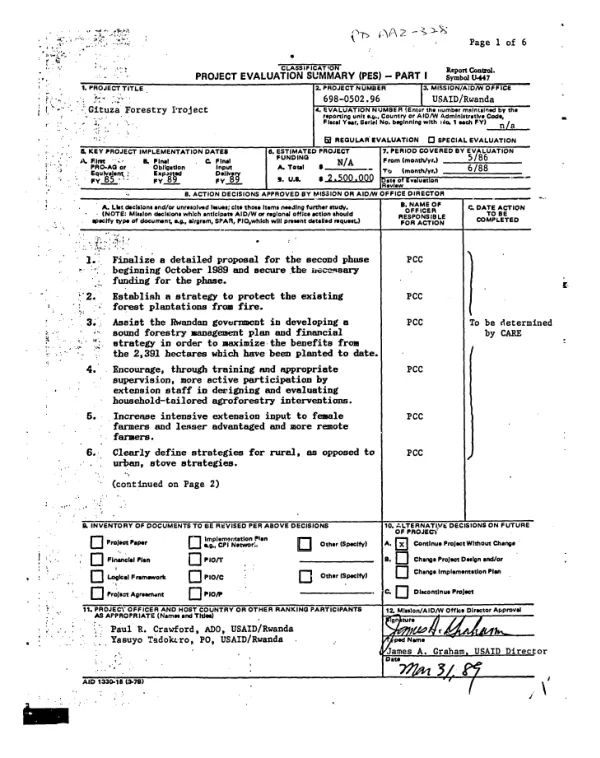
Summarizes unattached final evaluation (5/86-6/88) of a CARE project to implement a forestry program in the Gituza Commune of Rwanda.
1989
Sign in to readA free account is required to download.
Abstract
The evaluation was conducted 12 months prior to the PACD in part to provide input for a follow-on project, which will be financed by the Royal Dutch government. The project has an excellent record of target achievement, a high standard of quality in extension and research trials, and effective internal management. The reforestation and agroforestry components have achieved planting targets. About 2,500 ha of trees are now growing where bald hills loomed only 3 years ago, a central nursery has been established, and 8 existing nurseries were upgraded by improving management and adding demonstration plots. Commune residents exhibit real pride in the trees and nurseries, and have also benefited substantially from the job opportunities provided by the project. However, it will take about 16 years for the project nurseries and tree plantations to become financially self-sustaining, even considering seed sales from the commercialized nurseries. Until then, financial assistance will remain necessary. Options for financing future recurrent costs are included. The energy conservation component is one of the best examples of stove development in the region. The program has sold more than 2,000 charcoal stoves and 800 improved woodstoves and has installed a further 500 improved woodstoves. In addition, hundreds of housewives were instructed in improved household energy management, although these efforts were ultimately deemphasized in favor of stove development. Several lessons were learned. (1) Despite the overall success of the reforestation and agroforestry components, rates of farmer adoption of agroforestry technology varied widely (20-60%) due to the distance of some nurseries from farmers" homes, the increased cost of plants when the nurseries were commercialized, farmers" reluctance to plant trees in fields, and the negative attitudes of some farmer leaders. Forestry projects in general face a number of difficulties stemming from the perception of their impact among the local population. Careful management and adaptation to complex local socioeconomic conditions are essential. (2) Reforestation activities provided an excellent opportunity to improve the knowledge of local silviculture. A more varied plantation design might increase such opportunities. (3) More intensive attention and follow-up is required to market cookstoves in rural areas than in urban areas. Recommendations focus on maintenance and fire prevention, finanical sustainability, and additional participation by women and other less advantaged persons. CARE"s comments on the evaluation are appended.
Related documents