THE MOUNTAIN INSTITUTE
GLACIAL FLOODING AND DISASTER RISK MANAGEMENT: JULY 11-24, 2013
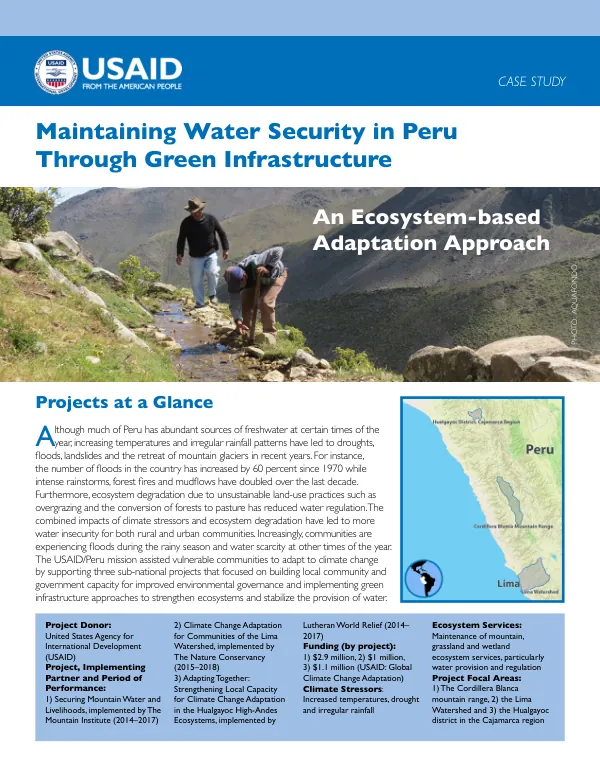
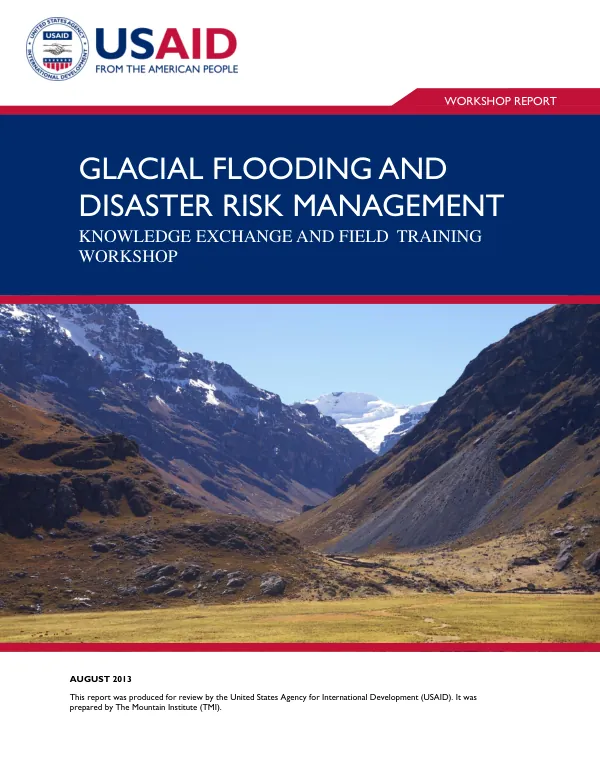
The High Mountains Adaptation Partnership (HiMAP) held its third international workshop, "Glacial Flooding and Disaster Risk Management Knowledge Exchange and Field Training," in the Cordillera Blanca Mountains of Peru from July 11 to 24, 2013.
2013 · 7 pages
Sign in to readA free account is required to download.
Abstract
The workshop was designed and implemented by the US Agency for International Development (USAID), Engility Corporation, The Mountain Institute (TMI), and the University of Texas at Austin (UT). The event brought together 47 participants from diverse backgrounds and foci to share knowledge and experiences in the field of glacial flooding and disaster risk management. The workshop featured presentations of HiMAP research results, including those of young Climber Scientist grantees, as well as training modules on new field methods in the high mountain sciences. These included ground penetrating radar (GPR) demonstrations at Pastoruri glacier, conflict resolution methods at Paron Glacial Lake, and new systems for developing local adaptation management plans in the Quilcay watershed above Huaraz. A group trek to the 4500 m Churup lake helped acclimate participants to the high altitude, and a more strenuous journey to Palcacocha Lake was undertaken by a subset of participants. The workshop also included a half-day discussion on the continued growth and expansion of the High Mountain Community of Practice (CoP), which was led by John Harlin, the High Mountain CoP Moderator and Senior Program Officer. Breakout groups discussed successes and lessons learned from the HMGWP, and participants voted to change the name of the CoP to the High Mountain Adaptation Partnership (HiMAP) from its previous title, High Mountain Glacier Watershed Program (HMGWP). The workshop ended with a three-day field trek over the 5200 meter Huapi Pass to Lake Palcacocha, one of the region's most dangerous glacial lakes. Cesar Portocarrero, an expert in the social, physical, and engineering aspects of controlling dangerous glacial lakes, led discussions regarding the lake's history, growth since the 1941 outburst, siphons installed a year ago in an effort to lower the lake's level, and plans for more substantial lowering through the installation of a 2 m diameter drainage pipe. The workshop generated numerous new ideas for future projects among the diverse experts, practitioners, and stakeholders in attendance. For example, Karma, from Bhutan's Department of Geology, suggested that the next workshop take place in Bhutan in 2014, while Vladimir Aizen from the University of Idaho and Muzaffar Shodmonov from the State Agency for Hydrometeorology in Tajikistan lobbied for the next conference to take place in Tajikistan. TMI's Nepali and American staff discussed the idea of a Nepali-led "Everest Alliance," which would establish a plan to mobilize worldwide attention towards conserving and sustainably managing the Mt. Everest ecosystem. The workshop was filmed and developed into a series of short videos available online on the HiMAP website. USAID looks forward to another busy year for HiMAP in its third year of implementation, August 2013-2014, including additional international workshops. The workshop was a significant event in the field of glacial flooding and disaster risk management, bringing together experts and practitioners to share knowledge and experiences and to generate new ideas for future projects. The Cordillera Blanca Mountains of Peru were chosen as the venue for the workshop due to their status as a "living laboratory" with numerous cutting-edge research and climate change adaptation projects in progress. The region's high altitude and glacial lakes make it a critical area for studying and mitigating the impacts of climate change. The workshop provided a unique opportunity for participants to spend time in the field together, resulting in numerous related discussions concerning the social and physical impacts of climate change in the high mountain environment. The workshop also highlighted the importance of USAID's work in building awareness for and decreasing the risk of another glacial lake outburst flood, which HiMAP modeling suggests could lead to as many as 30,000 deaths, with the town of Huaraz having the highest vulnerability. The workshop's focus on glacial flooding and disaster risk management is critical for reducing the vulnerability of communities in the region to these types of disasters.