USAID DEC
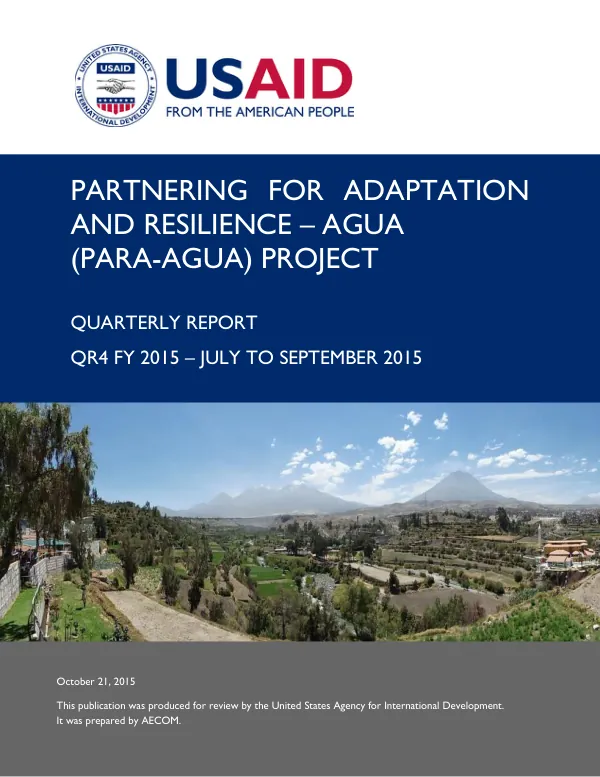
Partnering for Adaptation and Resilience – Agua (PARA-Agua) Project Quarterly Report (Year 2, Quarter 4)
Sign inUSAID
Partnering for Adaptation and Resilience – Agua (PARA-Agua) Project Quarterly Report (Year 2, Quarter 4)
The Partnering for Adaptation and Resilience – Agua (PARA-Agua) Project is a regional initiative aimed at strengthening climate change adaptation capacities and resilience by improving understanding of climate's impact on water resources.
2015 · 37 pages
Sign in to readA free account is required to download.
Abstract
The project started in October 2013 and concluded its first phase in September 2015. Initially, the project focused on two target watersheds: the Chira-Piura watershed in northern Peru and the Chinchina Watershed in central Colombia. Over the past year, the project incorporated two more watersheds, the Quilca-Chili Watershed in southern Peru and the Guatapuri Watershed in northern Colombia. During FY15Q4, PARA-Agua increased its coordination efforts with other international donors to collaborate in the fifth and newest watershed, Chancay-Lambayeque in northern Peru. The project's overall goals and objectives include strengthening the ability of up to four key glacier, snow, and ice research centers in the region to generate policy-oriented scientific data on high montane hydrological systems, ensuring that new climate data is integrated regularly into decision-making processes, and strengthening planning systems that optimize water use over the whole length of the watersheds. The expected outcomes of the project include new scientifically sound data on the dynamics of water resources, water management plans, investment analyses, program designs, engineering studies, and other decision-making tools, as well as public and private sector investments and new community-level water management programs and actions. The PARA-Agua Project has made significant progress in its third quarter, with major achievements in three key areas. In Task 1, Strengthening the Capacity of the Research Community to Generate Policy-Oriented Data on Watershed Management and Climate Change Adaptation, the online Science for Adaptation Community of Practice (CoP) is thriving, with the draft Toolkit 3 presented via the CoP to solicit revisions and commentaries by site users. The concept of Toolkit 4 was also presented to a group of international Cooperation Agencies that lead the climate change platform to begin dialog and solicit feedback. In Task 2, Mainstreaming and Integrating Climate Data into Decision-Making Related to Watershed Management, the PARA-Agua Project conducted the "Regional Climate Modeling Workshop" in the city of Lima, attended by 50 individuals. In the Guatapuri (Colombia) Basin, PARA-Agua completed the development of a WEAP application. In Task 3, Strengthening Planning Systems that Optimize Water Use over the Whole Length of the Watersheds, PARA-Agua has made progress in developing and implementing planning systems that optimize water use. The PARA-Agua Project has also made significant progress in its cross-cutting activities, including the execution of Memorandums of Understanding (MOUs) with Twinning Partners in California and the holding of gender and climate change workshops in Peru and Colombia, reaching 80 different participants. The project has also published two articles in IRAGER's institutional magazine, which circulates nationally in Peru. The PARA-Agua Project is implemented by AECOM International Development in accordance with the U.S. Agency for International Development (USAID) contract number AID-OAA-TO-13-00037. The project has a total funding of USD 7,995,163.82 (Cost Plus Fixed Fee including option years) and started on September 9, 2013, with an end date of September 8, 2015 (base period).