ACDI/VOCA
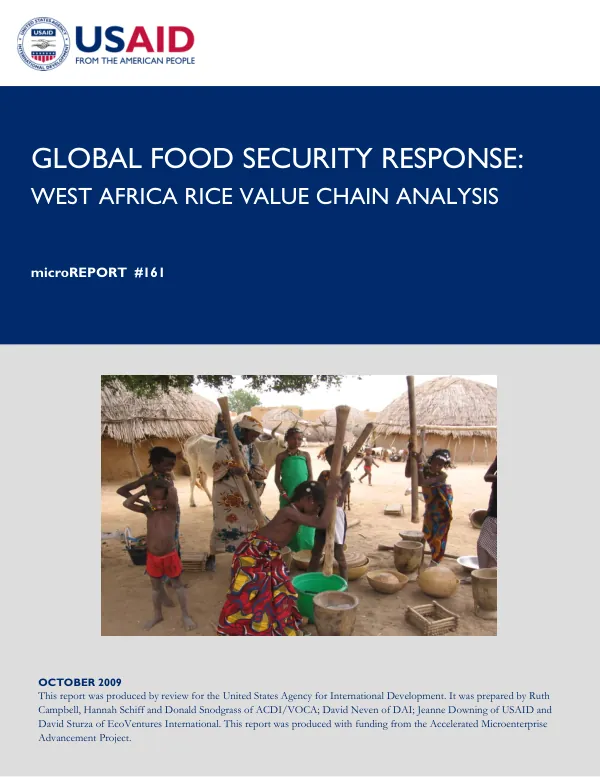
Global Food Security Response: West Africa Rice Value Chain Analysis
Rice production in West Africa has struggled to meet increasing demand driven by population growth, rapid urbanization, and rising incomes.
2009 · 83 pages
Sign in to readA free account is required to download.
Abstract
As a result, the region relies heavily on imports to meet half of its rice demand. The global rice market experienced a significant price surge in the spring of 2008, with prices tripling in less than four months and reaching a 30-year high. This price increase posed a significant challenge for West African countries, which were previously able to afford price interventions to protect domestic rice consumers. The region's reliance on imports is largely due to the inability of local rice production to keep pace with growing demand. West Africa's population is projected to continue growing, with urbanization rates expected to increase significantly. This trend is likely to further strain the region's rice production capacity, making imports an essential component of the regional food system. The economic implications of this trend are significant, with regional rice imports totaling over 6 million metric tons per year. The 2008 food crisis, triggered by rising oil and bio-fuel prices and a weak US dollar, highlighted the vulnerability of West Africa's food systems. However, longer-term trends have also contributed to the region's rice production challenges. These include declining yields, inadequate irrigation systems, and limited access to credit and other inputs for smallholder farmers. The region's rice value chain is characterized by a complex network of producers, processors, and traders, with multiple stakeholders influencing the flow of goods and services. The West Africa Rice Value Chain Analysis report identifies several key constraints to the region's rice industry competitiveness. These include inadequate infrastructure, limited access to credit and other inputs, and a lack of coordination among stakeholders. The report also highlights the importance of improving the business enabling environment, enhancing the competitiveness of smallholder farmers, and promoting the use of information and communications technology (ICT) to improve the efficiency of the rice value chain. A ten-year vision for upgrading the West Africa rice value chain is outlined in the report, with a focus on improving the competitiveness of the region's rice industry. This vision includes increasing rice production and productivity, improving the efficiency of the rice value chain, and enhancing the competitiveness of smallholder farmers. The report also provides recommendations for implementing this vision, including the development of a regional rice strategy, the establishment of a rice industry association, and the promotion of public-private partnerships to support the development of the rice value chain. The report highlights the importance of addressing the systemic constraints to the region's rice industry competitiveness, including inadequate infrastructure, limited access to credit and other inputs, and a lack of coordination among stakeholders. The development of a regional rice strategy and the establishment of a rice industry association are seen as critical components of this effort. The report also emphasizes the need for public-private partnerships to support the development of the rice value chain, including the provision of credit and other inputs to smallholder farmers. The West Africa Rice Value Chain Analysis report provides a comprehensive overview of the region's rice production and trade dynamics. The report highlights the challenges facing the region's rice industry, including declining yields, inadequate irrigation systems, and limited access to credit and other inputs. The report also outlines a ten-year vision for upgrading the West Africa rice value chain, with a focus on improving the competitiveness of the region's rice industry. The report provides recommendations for implementing this vision, including the development of a regional rice strategy, the establishment of a rice industry association, and the promotion of public-private partnerships to support the development of the rice value chain.