USAID DEC
Managing Rivers Across National Boundaries: Climate Change and the Need for Cooperative Management
Sign inUNITED NATIONS ENVIRONMENTAL PROGRAMME , NAIROBI
Managing Rivers Across National Boundaries: Climate Change and the Need for Cooperative Management
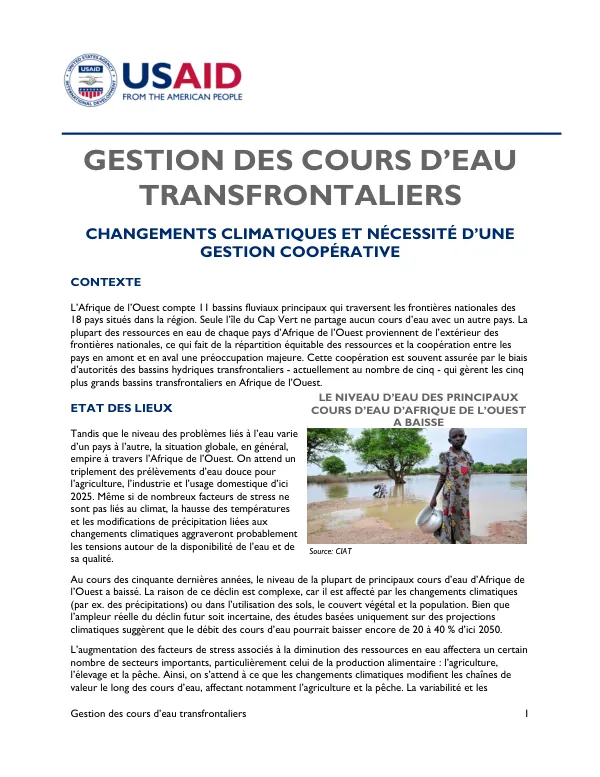
West Africa has 11 major river basins that cross national boundaries, with 18 countries in the region sharing at least one river with another country.
2014 · 2 pages
Sign in to readA free account is required to download.
Abstract
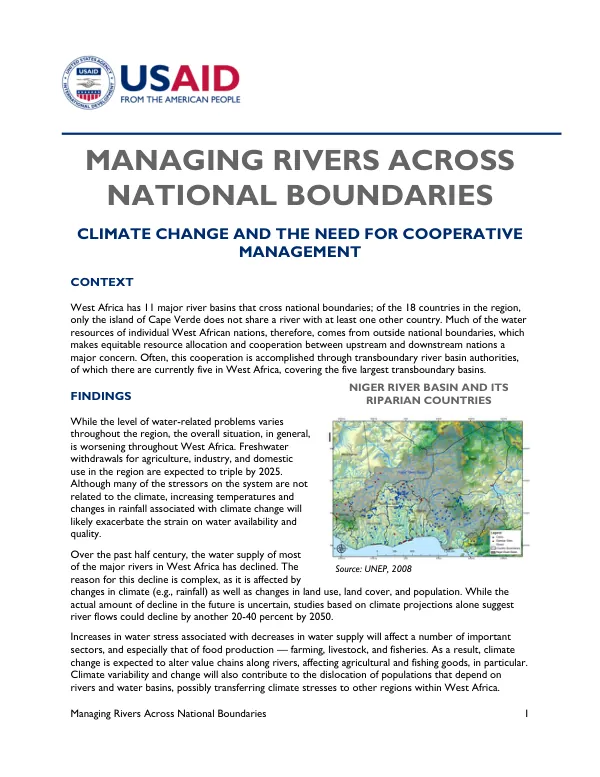
The Niger River Basin, one of the five largest transboundary basins in West Africa, spans across eight countries, including Benin, Burkina Faso, Cameroon, Chad, Mali, Niger, Nigeria, and Senegal. The basin's riparian countries face significant challenges in managing their shared water resources due to the complex relationship between changing climatic conditions and water supply. Climate change is expected to exacerbate the strain on water availability and quality in West Africa. Freshwater withdrawals for agriculture, industry, and domestic use in the region are projected to triple by 2025, while the water supply of most major rivers has declined over the past half century. Studies based on climate projections suggest that river flows could decline by another 20-40 percent by 2050. The decline in water supply will affect various sectors, including food production, with climate change expected to alter value chains along rivers, particularly affecting agricultural and fishing goods. The Senegal River Basin, another major transboundary basin in West Africa, spans across six countries, including Guinea, Mali, Mauritania, Morocco, Senegal, and The Gambia. The basin's riparian countries face similar challenges in managing their shared water resources, with climate change expected to exacerbate the strain on water availability and quality. The Lake Chad Basin, which spans across eight countries, including Cameroon, Chad, Niger, Nigeria, and Sudan, is also affected by climate change, with the basin's water supply declining over the past half century. Transboundary river basin authorities play a crucial role in managing shared water resources in West Africa. There are currently five such authorities in the region, covering the five largest transboundary basins. While these authorities have both strengths and weaknesses in addressing climate change, additional research is needed to identify their exact needs and capacities. Development organizations can make valuable contributions in the region by helping to build the capacity of transboundary river basin management institutions and supporting their efforts to collaborate with one another and adaptively co-manage transboundary basins. The complex relationship between changing climatic conditions and water supply in West Africa requires further research to clarify causal relationships. For example, research is needed to determine the influence of climate change relative to non-climate factors such as population growth, increased demand for hydropower and irrigation, changes in land use, and to better understand the institutional capacity of all five river basin authorities. Follow-up research is also needed on the smaller transboundary river basins, such as Tanoé and Cross, and the Fouta Djallon Mountains of Guinea, where five of the 11 basins have their source.
Related documents