USAID DEC
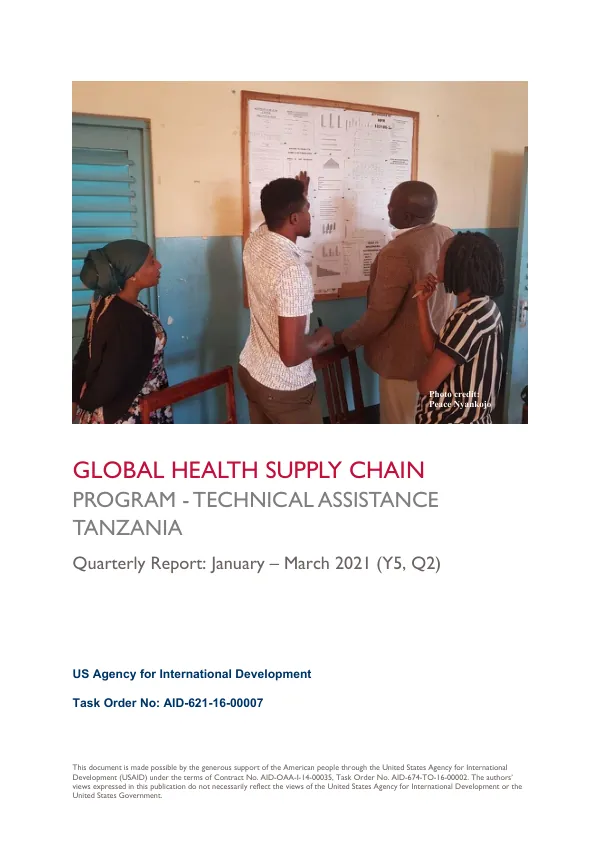
Global Health Supply Chain Program - Technical Assistance Quarterly Report: January – March 2021 (Y5, Q2)
Sign inUSAID
Global Health Supply Chain Program - Technical Assistance Quarterly Report: January – March 2021 (Y5, Q2)
The Global Health Supply Chain Program - Technical Assistance in Tanzania is a USAID-funded initiative aimed at strengthening the country's health supply chain system.
2021 · 48 pages
Sign in to readA free account is required to download.
Abstract
The program's objectives are to provide strategic planning and implementation assistance, improve delivery of health commodities in service sites, broaden stakeholder understanding and engagement of the supply chain system, and strengthen enabling environments to improve supply chain performance. Strategic planning and implementation assistance are provided through several interventions, including assisting leadership to operationalize strategic plans, planning for transition from donor-funded support, and further clarifying operating procedures. The rollout of the Health Commodities Revolving Fund guidelines and the Total Health Commodities Financial Needs Assessment are key components of this objective. Improvement of delivery of health commodities in service sites is another key objective of the program. This is achieved through interventions such as strengthening supply chain management information systems, strengthening and streamlining quantification, and broadening stakeholder understanding and engagement of the supply chain system. The program focuses on five commodity groups: HIV, reproductive and child health, malaria, TB, and essential health commodities. The program also aims to strengthen enabling environments to improve supply chain performance. This is achieved through interventions such as solidifying the Local Medical University's role in information sharing and oversight, strengthening governance and accountability, and institutionalizing data use. Implementation challenges, risks, and mitigation measures are also addressed in the program. The program's quarterly report highlights key accomplishments, including the rollout of the Health Commodities Revolving Fund guidelines, the Total Health Commodities Financial Needs Assessment, and the strengthening of supply chain management information systems. The program's performance is monitored through several indicators, including stock out rates, stocked according to plan, and ELMIS issues reported and resolved within 24 hours. The program's progress is also tracked through various figures and tables, including the overall stockout rates, overall stocked according to plan, and severe malaria case trends. The program's training and travel activities are also documented, including the number of people who log into ELMIS, the percentage of R&R passing data quality check, and the list of Q2Y5 training and travel activities. The program's quarterly report provides a comprehensive overview of its progress and achievements, highlighting key accomplishments, challenges, and mitigation measures.