USAID DEC
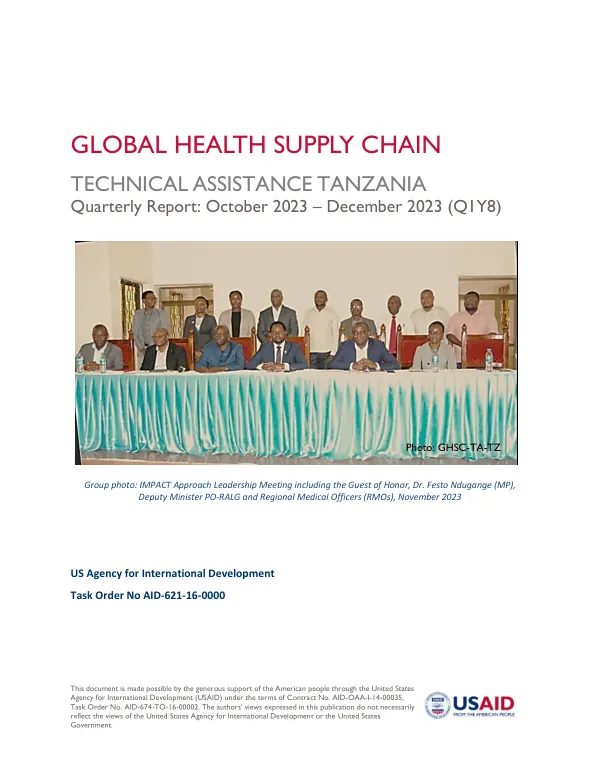
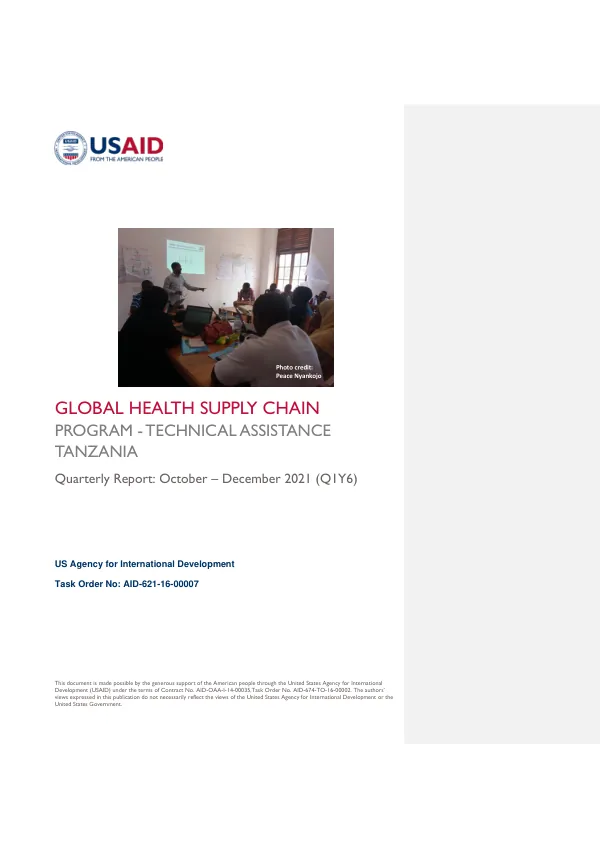
Global Health Supply Chain Program - Technical Assistance Quarterly Report: October – December 2021 (Q1Y6)
Sign inUSAID
Global Health Supply Chain Program - Technical Assistance Quarterly Report: October – December 2021 (Q1Y6)
The Global Health Supply Chain Program - Technical Assistance in Tanzania is a quarterly report covering the period from October to December 2021.
2021 · 66 pages
Sign in to readA free account is required to download.
Abstract
The program aims to improve the delivery of health commodities in service sites, strengthen supply chain management information systems, and broaden stakeholder understanding and engagement of the supply chain system. The program has made significant progress in achieving its objectives. Key accomplishments this quarter include the operationalization of the Zanzibar Supply Chain Strategic Plan 2021/2026, the development of donation guidelines for medicines and medical supplies, and the COVID-19 Response Plan 2021/2022. The program has also made progress in transitioning from donor-funded support, with the eLMIS transition and the Health Commodities Revolving Fund Guideline being key interventions. The program has also strengthened supply chain management information systems, with the COVID-19 Commodity Reporting in eLMIS and the Zanzibar Digital Health Strategy Implementation Support being key interventions. The program has also improved supply chain agility to respond to health priorities, with the IMPACT Approach and Capacity Building being a key intervention. The program has also made progress in broadening stakeholder understanding and engagement of the supply chain system. Key interventions include the institutionalization of data use and improvement of data quality, with the Development of Data Quality Assessment (DQA) Protocol being a key activity. The program has also assisted the Ministry of Health, Community Development, Gender, Elderly, and Children (MOHCDGEC) to budget for health commodities, and strengthened RHMTs and CHMTs and other supply chain stakeholders to proactively manage health commodities and their movements. The program has also faced implementation challenges, risks, and mitigation measures. Key challenges include stock out rates for tracer commodity groups, with the stock out rate for TLD, Lopinavir/Ritonavir 200/50mg, and Atazanavir/Ritonavir 300/100mg (ARVs) being above the target of 5%. However, the program has implemented mitigation measures, including the redesign of the logistics system and the strengthening of supply chain management information systems. The program has also made progress in implementing the Project Management Plan, with key activities including the training and travel of staff, and the management of risks and challenges. The program has also made progress in implementing the tracer commodity stock out rate status, with the stock out rate for tracer commodity groups being below the target of 5% for most groups. Overall, the Global Health Supply Chain Program - Technical Assistance in Tanzania has made significant progress in achieving its objectives, with key accomplishments including the operationalization of the Zanzibar Supply Chain Strategic Plan 2021/2026, the development of donation guidelines for medicines and medical supplies, and the COVID-19 Response Plan 2021/2022. The program has also strengthened supply chain management information systems, improved supply chain agility to respond to health priorities, and broadened stakeholder understanding and engagement of the supply chain system. The program has also faced implementation challenges, risks, and mitigation measures, including stock out rates for tracer commodity groups. However, the program has implemented mitigation measures, including the redesign of the logistics system and the strengthening of supply chain management information systems. The program has also made progress in implementing the Project Management Plan, with key activities including the training and travel of staff, and the management of risks and challenges. The program's success is attributed to the collaboration and coordination among stakeholders, including the Government of Tanzania, the Government of Zanzibar, and other partners. The program's progress is also attributed to the effective management of risks and challenges, and the implementation of mitigation measures. The program's future plans include continuing to strengthen supply chain management information systems, improving supply chain agility to respond to health priorities, and broadening stakeholder understanding and engagement of the supply chain system. The program will also continue to implement the Project Management Plan, with key activities including the training and travel of staff, and the management of risks and challenges. Overall, the Global Health Supply Chain Program - Technical Assistance in Tanzania has made significant progress in achieving its objectives, and has the potential to improve the delivery of health commodities in service sites, strengthen supply chain management information systems, and broaden stakeholder understanding and engagement of the supply chain system.
Related documents