USAID DEC
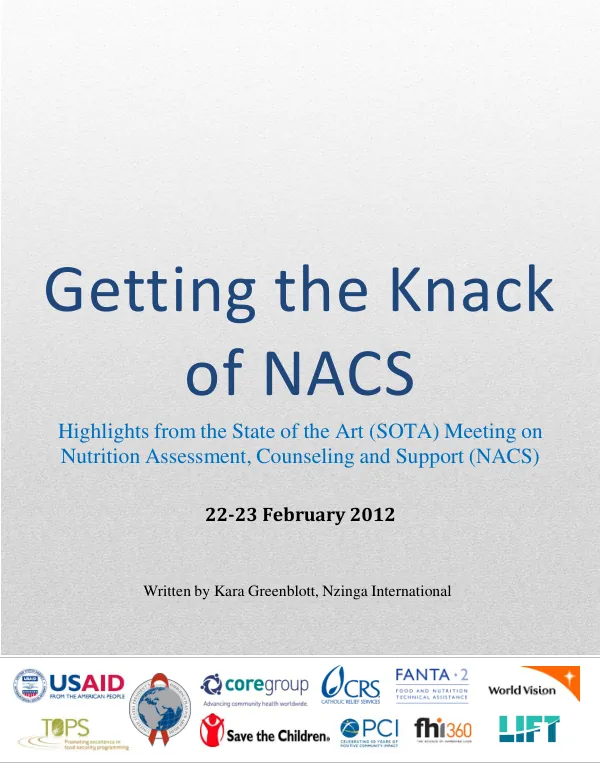
Getting the Knack of NACS: SOTA Meeting on Nutrition Assessment, Counseling and Support
Sign inCATHOLIC RELIEF SERVICES ORGANIZATION
Getting the Knack of NACS: SOTA Meeting on Nutrition Assessment, Counseling and Support
The integration of HIV and nutrition programming has been increasingly recognized as imperative for successful HIV treatment outcomes over the past decade.
2012 · 33 pages
Sign in to readA free account is required to download.
Abstract
As the evidence accumulated for 'integrated' programming, Food by Prescription (FBP) emerged as a way to treat Severe Acute Malnutrition (SAM) and Moderate Acute Malnutrition (MAM) for People Living with HIV/AIDS (PLHIV) on Antiretroviral Therapy (ART) and to bolster adherence to life-saving ARVs. However, a shift has occurred in recent years, with stakeholders recognizing the importance of balancing emphasis among nutrition assessment, counseling, and support (including food and nutrition supplements when necessary), as well as intervening before malnutrition occurs. This shift is relevant and compelling not only in an HIV context but to nutrition programming more broadly. Nutrition Assessment, Counseling, and Support (NACS) has initially emerged from nutrition programming within an HIV context, but today NACS is for everyone, and contributes to achieving the goals that the nutrition community has long been promoting. The NACS framework has evolved into an aspiration to deliver adequate prevention and treatment of malnutrition for all. The NACS framework encompasses several key components, including nutrition assessment, counseling, and support. Nutrition assessment involves identifying individuals who are at risk of malnutrition or who are already malnourished. Counseling provides individuals with the knowledge and skills necessary to make informed decisions about their nutrition and health. Support involves providing individuals with the resources and services necessary to implement the recommendations made during counseling. Several promising examples of how NACS programming has worked have been identified. In Uganda and Kenya, experience has shown that delivering quality NACS programming can lead to improved health outcomes for individuals living with HIV/AIDS. In Zambia and Malawi, lessons have been learned about the importance of integrating NACS programming with other health services. In Namibia, Ethiopia, and Mozambique, promising practices have been identified that can be replicated in other contexts. The NACS framework has several benefits, including improved health outcomes for individuals living with HIV/AIDS, reduced mortality rates, and improved quality of life. However, there are also costs associated with implementing NACS programming, including the cost of training health workers and the cost of providing nutrition supplements. To apply NACS in country-specific contexts, several steps can be taken. First, a needs assessment should be conducted to identify the specific needs of the population. Second, a NACS framework should be developed that takes into account the local context and resources. Third, training should be provided to health workers on the NACS framework and how to implement it. Finally, resources should be allocated to support the implementation of NACS programming. The NACS framework has the potential to make a significant impact on the health and well-being of individuals living with HIV/AIDS and other vulnerable populations. By integrating NACS programming with other health services and providing individuals with the knowledge, skills, and resources necessary to make informed decisions about their nutrition and health, NACS can help to improve health outcomes and reduce mortality rates.
Related documents