US NATIONAL OCEANOGRAPHIC AND ATMOSPHERIC ADMINISTRATION
Global Weather Hazards Summary
The Famine Early Warning Systems Network (FEWS NET) provides a global weather hazards summary, focusing on Africa, Central Asia, and Central America.
2014 · 4 pages
Sign in to readA free account is required to download.
Abstract
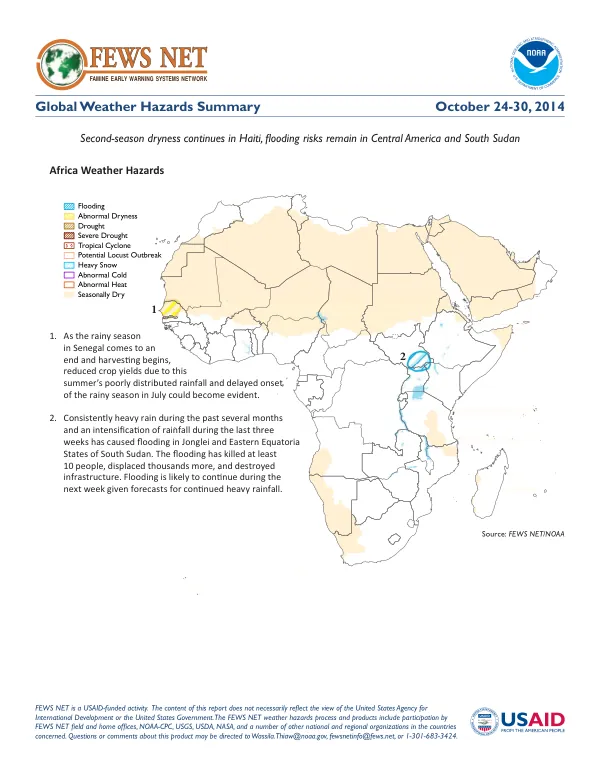
The report highlights various weather-related hazards, including flooding, drought, and abnormal dryness. In Africa, heavy rain has caused flooding in Jonglei and Eastern Equatoria States of South Sudan, resulting in at least 10 deaths, thousands of displaced people, and destroyed infrastructure. The flooding is likely to continue during the next week due to forecasts for continued heavy rainfall. Heavy rains have also fallen across a wide portion of eastern Africa, with the heaviest rains recorded in South Sudan, southern Sudan, western Ethiopia, and areas around Lake Victoria. Abundant rains in Rwanda have improved ground moisture, while only localized showers fell across central/southern Somalia. Much of eastern Africa has received above-average rainfall over the past 30 days, with rainfall in western Ethiopia, Somali Region of Ethiopia, South Sudan, and central/northern Somalia being 50-200 mm above-average. However, a slow start to Deyr seasonal rains has led to rainfall deficits in southern Somalia. During the next week, heavy rains are forecast for areas around Lake Victoria, stretching north to southern parts of South Sudan, while locally moderate to heavy rain is expected for Somali Region of Ethiopia and central/southern Somalia. In West Africa, below-average rainfall is expected across the region next week, which will increase rainfall deficits across bi-modal areas along the Gulf of Guinea. Heavy rainfall has been observed across saturated areas in Guinea, Sierra Leone, and Liberia, as well as Nigeria and localized areas in Ghana, Togo, and Benin. Moderate rainfall has been observed across dry areas in Senegal, while little rainfall has been recorded across the Sahel and coastal Côte d'Ivoire and Ghana. In Central Asia, temperatures have averaged 1-7°C above normal across most of the region from October 12-18, except for extreme northern Kazakhstan, where below-normal temperatures were observed. Minimum temperatures have fallen below -5°C during the past week across northern Kazakhstan, and during the next week, minimum temperatures could fall to -10°C across northern Kazakhstan, with freezing temperatures spreading as far south as Turkmenistan and Uzbekistan. Widespread precipitation has fallen across the northern third of Kazakhstan, while locally heavy rain has fallen along the border of Afghanistan and Pakistan. Snowfall analysis indicates that snow depths are increasing across the higher elevations of northeast Afghanistan and Tajikistan. In Central America, despite some increases in rainfall over central Hispaniola in September, southern and northwestern parts of Haiti, along with northwestern and southern Dominican Republic continue to be drier than normal. Heavy and above-average rainfall has triggered flooding and landslides in Chimaltenango, Zacapa, Guatemala, Baja Verapaz, and Petén Departments of Guatemala and San Pedro Sula region of western Honduras during the past week. Risks for flooding and landslides are high along the northern coasts of Honduras and over already-saturated areas of Guatemala due to the forecast track of Tropical Depression Nine into the Yucatan Channel and associated heavy rains during the next week. Thirty-day rainfall surpluses have been observed over much of Central America, with rainfall surpluses of 200-400 mm recorded over the Pacific coasts, Quiché, and Izabal Departments of Guatemala and along the Gulf of Fonseca region. Heavy and above-average rains have fallen over much of Guatemala, the Gulf of Fonseca, and Costa Rica, causing flooding and infrastructure damages in Chimaltenango, Baja Verapaz, Guatemala, Petén, and Zacapa Departments of Guatemala. Heavy rains have also caused flooding in San Pedro Sula of western Honduras and overflowing of the Esteli River in north-central Nicaragua.
Related documents