US NATIONAL OCEANOGRAPHIC AND ATMOSPHERIC ADMINISTRATION
Global Weather Hazards Summary
The Famine Early Warning Systems Network (FEWS NET) is a USAID-funded activity that provides global weather hazards summaries.
2014 · 4 pages
Sign in to readA free account is required to download.
Abstract
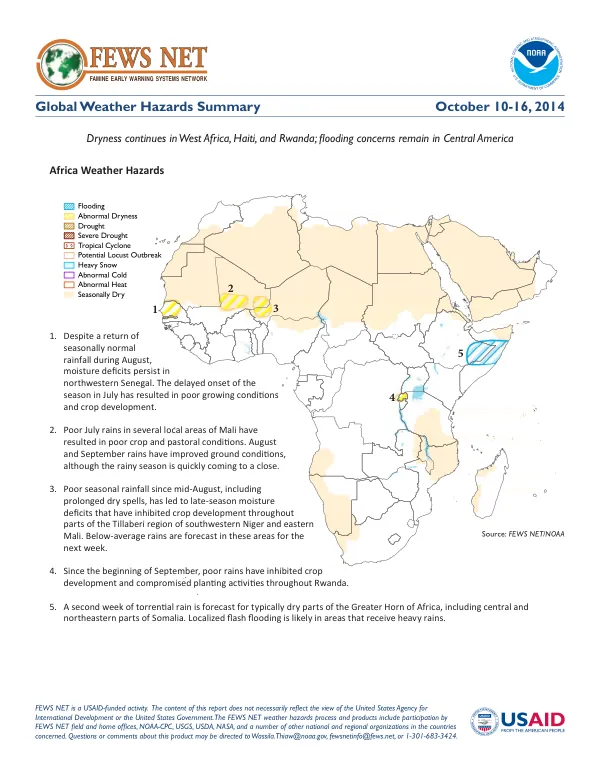
The network's weather hazards process and products include participation by FEWS NET field and home offices, NOAA-CPC, USGS, USDA, NASA, and other national and regional organizations. The summaries are based on current weather and climate information, short and medium-range weather forecasts, and their potential impact on crop and pasture conditions. In West Africa, dryness persists in several countries, including Senegal, Mali, and Niger. Despite a return of seasonally normal rainfall in August, moisture deficits persist in northwestern Senegal due to a delayed onset of the rainy season. Poor July rains in Mali have resulted in poor crop and pastoral conditions, although August and September rains have improved ground conditions. In Rwanda, poor seasonal rainfall since mid-August has inhibited crop development and compromised planting activities. In Central America, flooding concerns remain due to heavy rainfall in several countries. Above-average rains have caused flooding and landslides in San Marcos Department of western Guatemala, and potential for flooding remains high as additional localized heavy rains are forecast during the next week. A weather disturbance off the Pacific coasts of Costa Rica and Nicaragua could potentially bring torrential rains along the Pacific rim of Central America, elevating the risks for flooding and landslides. In Africa, above-average rains continue across the Sahel region, with heavy rains falling across Mali, Niger, Guinea, Sierra Leone, and Liberia. Moderate rain has fallen in Côte d'Ivoire and southern Niger, and light rains have fallen in Senegal. The West African Monsoon season is coming to a close, with 30-day rains above average in central/western West Africa but below average in the east. Despite these improvements, seasonal and short-term moisture deficits remain in local areas in southwestern Niger and bordering Mali. In East Africa, heavy, late-season rains have continued across a wide portion of the region, with above-average rains falling across Ethiopia, northern Somalia, South Sudan, and areas around Lake Victoria. The abundant rain in Ethiopia is expected to benefit areas that received poorly distributed and erratic rains earlier in the Kiremt rainy season. Rains in South Sudan and northern Somalia likely resulted in localized flooding due to the heavy nature of the showers.