CHEMONICS
Governance Strengthening Project (Taqadum) Quarterly Performance Report (Y3Q2)
Governance Strengthening Project (Taqadum) achieved significant breakthroughs in multiple program elements during the second quarter of FY2014, from January 1, 2014 to March 31, 2014.
2014 · 58 pages
Sign in to readA free account is required to download.
Abstract
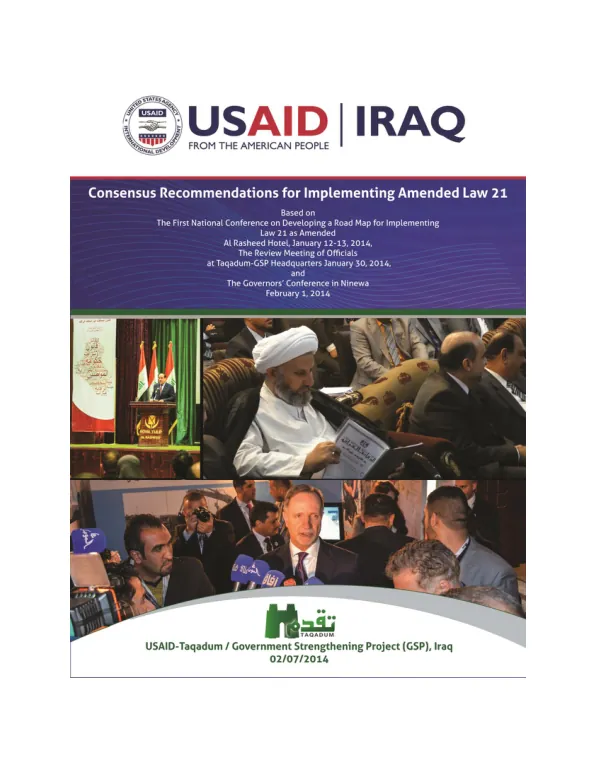
The project brought the issue of decentralization into the public domain in a way that has never previously been done in Iraq. On January 12, 2014, Prime Minister Nouri Al-Maliki delivered a speech on the issue during Taqadum's Expo Conference on Developing a Roadmap for Implementing Law 21, as Amended. Since that event, local governments across Iraq have embraced the inevitability of decentralization as its defining cause and are seeking to understand how best to accomplish this significant shift in ownership of providing services to citizens. Another breakthrough during the quarter was the willingness by very high-level and influential Government of Iraq (GoI) officials to consider modifications to the financial regulatory framework to improve the execution rate of the investment budget. Both the Secretary General of the Council of Ministers and Head of the Prime Minister's Advisory Council (PMAC) are supportive of changes to the legal framework and the study delivered by Taqadum to the Head of PMAC, which identifies legal and administrative obstacles for implementation of the investment budget, gives the GoI substantive input to consider. Taqadum's Organizational Self-Assessment and Transformation Program (OSTP) improvement solutions were fully implemented in some provinces while others have started implementation. Since all the OSTP teams (with the exception of Erbil) have gone through the transformation process, they are now better equipped to address the challenges facing the provincial councils. The project also made progress in its other program elements, including financial management and budget, provincial planning and development councils, community outreach and citizen participation, and capacity building for new provincial councils and Erbil Governorate. The project's monitoring and oversight of capital projects, essential service delivery oversight, citizen satisfaction surveys, citizen service desks, and sub-legislative implementation tracking system also showed significant progress during the quarter. The project's gender and coordination activities were also implemented, and challenges were identified and addressed. The project's staffing and procurement activities were also completed, and the project's summary of anticipated activities for the third quarter (April 1 to June 30, 2014) was prepared. The project's accomplishments during the quarter were significant, and the project is on track to meet its expected outcomes. The project's performance indicators, including the number of provincial councils that have implemented the OSTP improvement solutions, the number of local governments that have embraced decentralization, and the number of GoI officials who are supportive of changes to the financial regulatory framework, will be closely monitored to ensure that the project is meeting its expected outcomes.