USAID DEC
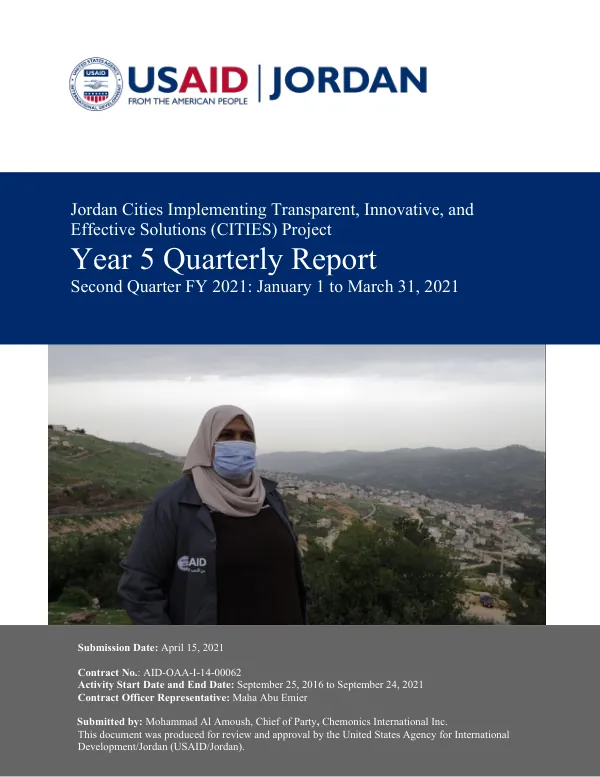
Jordan Cities Implementing Transparent, Innovative, and Effective Solutions (CITIES) Year 3 First Quarterly Report
Sign inCHEMONICS
Jordan Cities Implementing Transparent, Innovative, and Effective Solutions (CITIES) Year 3 First Quarterly Report
The CITIES project in Jordan aims to increase the effectiveness of municipal governance and support decentralization.
2019 · 71 pages
Sign in to readA free account is required to download.
Abstract
Awarded in September 2016, the five-year project seeks to strengthen locally driven development by supporting local development directorates and governorate level councils. CITIES recognizes the dual role of the Jordanian municipality as both a direct service provider and an intermediary to access resources from governorate and national level bodies. The project's integrated approach focuses on implementing innovative and sustainable solutions to improve service delivery, increasing the sustainability of current municipal operations, and enhancing capacity to promote community resilience. Key accomplishments in the first quarter of Year 3 include the development of a Decentralization Mapping and Analysis Plan (DMAP) to support the decentralization process in Jordan. The DMAP aims to identify and analyze the strengths, weaknesses, opportunities, and threats (SWOT) of the decentralization process, providing a framework for decision-making and resource allocation. The project also made progress in improving service delivery, with a focus on solid waste management (SWM) and municipal institutional capacity assessment (MICA). The SWM component aimed to improve waste collection and disposal services in selected municipalities, while the MICA component aimed to assess the institutional capacity of municipalities to deliver services effectively. Key accomplishments in this area include the completion of a SWM assessment in three municipalities and the development of a MICA report for 10 municipalities. In addition, the project made progress in increasing the sustainability of current municipal operations. This included the development of a financial management information system (FMIS) to improve financial management and reporting in municipalities. The FMIS aims to provide municipalities with a comprehensive and user-friendly system for managing their finances, enabling them to make informed decisions and improve service delivery. The project also made progress in enhancing capacity to promote community resilience. This included the development of a community engagement project (CEP) to support community-led development initiatives. The CEP aims to empower communities to take ownership of their development initiatives, promoting community resilience and self-sufficiency. Overall, the CITIES project in Jordan has made significant progress in its first quarter of Year 3, with a focus on improving service delivery, increasing sustainability, and enhancing capacity to promote community resilience. The project's integrated approach and commitment to decentralization and community-led development have positioned it well to achieve its objectives and contribute to the development of Jordan's municipalities.