USAID DEC
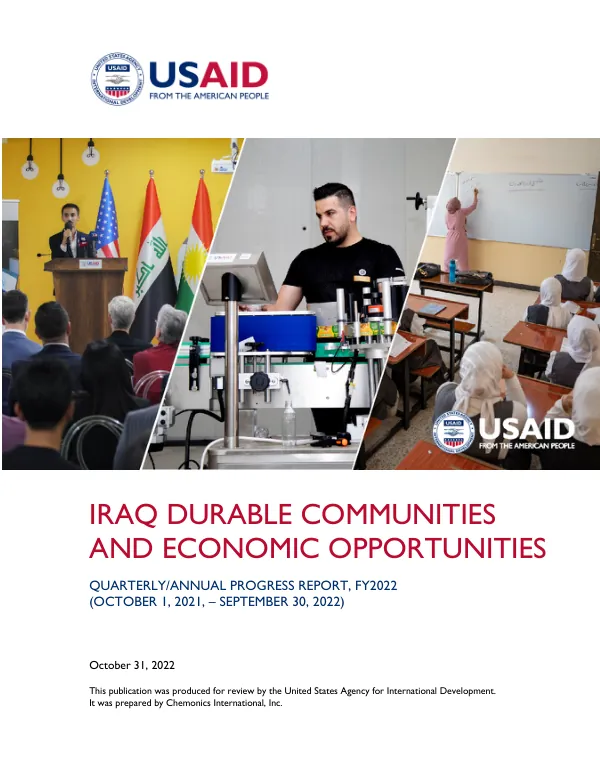
Iraq Durable Communities and Economic Opportunities Quarterly Progress Report Year 2 Quarter 1 (October 1 – December 31, 2020)
Sign inCHEMONICS
Iraq Durable Communities and Economic Opportunities Quarterly Progress Report Year 2 Quarter 1 (October 1 – December 31, 2020)
The Iraq Durable Communities and Economic Opportunities (DCEO) project gained considerable momentum during the reporting period as Implementation Plans had been approved, the Senior Management Team (SMT) was reunited in Iraq, and staffing for newly issued task orders was almost completed.
2020 · 37 pages
Sign in to readA free account is required to download.
Abstract
COVID continued to be a challenge, curtailing travel, reducing meeting possibilities, and requiring much more investment in communications. Nonetheless, DCEO was able to undertake all the preparatory groundwork for full implementation in the next quarter. The preparatory groundwork included the work of the Business Competitiveness and Job Creation Initiative (BCJCI), building a client (business firm) pipeline, assessing potential firms for assistance, and setting the rhythm of the Deal Review Board which sets the stage for a fully developed Client Growth Plan (CGP). It is that signed CGP which will provide assistance and funding to the firms. BCJCI expanded its network of business and trade association contacts and developed an Annual Program Statement as a vehicle to actualize those relationships in early 2021. On 100 Solutions for Stability (100 Solutions), DCEO developed detailed area profiles of the six selected communities to enable the project to approach the communities appropriately. Community engagements began in the first month of the reporting period and continued throughout, resulting in initial 'quick win' confidence building projects. These engagements were a first step toward full community dialogues set for early 2021. The Marla Ruzicka Iraqi War Victims Fund kicked off quickly with DCEO partner Pre-Emptive Love Coalition (PLC) launching one on one business support in Dohuk, Sinjar, Mosul, and WorkWell programs for those areas and Basrah as well. A request for applications (RFA) drew in a large number of organizations wishing to work with DCEO in support of helping Marla Fund eligible beneficiaries restart jobs, businesses, and livelihoods. The Learning Task Order developed a learning agenda to guide collection of data and ongoing analysis ahead of learning events planned for summer 2021. This task order quickly emerged as a nexus point for the entire DCEO project. Through it all, COVID continued to stalk the landscape as did U.S.-Iran tension and enormous economic hardship in Iraq. Nonetheless, the DCEO team proved itself able to adapt to the circumstances and rise to the occasion, keeping the project on schedule and on target. The DCEO project is designed to support Iraqis in their efforts to re-establish stable and resilient communities. This five-year project has two main objectives, each of which has two sub-objectives. The first objective is to increase adaptive capacity of vulnerable communities by mitigating drivers of conflict in target communities and enhancing community leadership of inclusive development. The second objective is to advance the economic well-being of communities by improving private sector networks and increasing micro, small, medium enterprise (MSME) development. DCEO is working with local businesses to identify potential areas for growth that will expand their operations, in turn creating new jobs and contributing to an improved local economy. DCEO is also working with communities and local leaderships as they identify specific, local drivers of conflict and enact practical solutions. Similarly, the project will support local business associations and networks, in collaboration with the business community, to identify shared impediments to growth and trade and to collectively advocate. These activities will be supported through capacity building and grants. The Management Task Order provides overall leadership and support for DCEO. The COP, along with Senior Management Team (SMT) members who lead the monitoring, evaluation, and learning (MEL), communications, grants, operations, security, and technical advisory teams worked closely with the task order directors to provide the expertise and effort required to ensure effective planning and implementation. The Technical Advisory Team (TAT) continued to provide support to both implementation task orders, completing area profiles, identifying potential firms for assistance, and in reviewing potential grantees. The TAT also took the lead in designing and conducting two training curricula to build the capacity of DCEO staff as they prepared to engage with beneficiaries and counterparts.