CHEMONICS
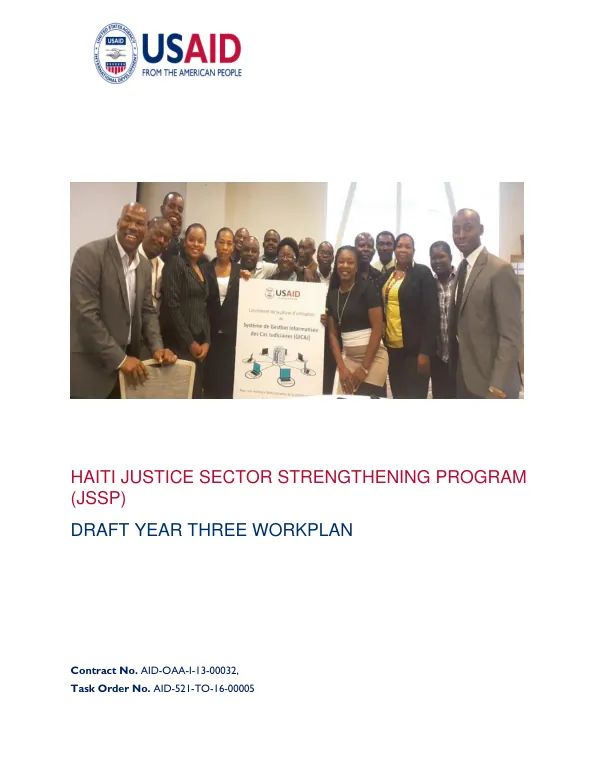
Haiti Justice Sector Strengthening Program (JSSP) Draft Year Three Workplan
The Haiti Justice Sector Strengthening Project (JSSP) aims to drive critical justice reforms in Haiti, including the modernization of the penal code and penal procedure code, the adoption of the first national legal assistance system and gender policy, and the automation of the court system.
2018 · 26 pages
Sign in to readA free account is required to download.
Abstract
In Year 3, JSSP will build on its successful achievements by implementing the legal assistance legislation and adopting the penal and penal procedure codes. Implementation of the codes requires continued support from JSSP to a comprehensive strategy, encompassing activities such as lobbying, technical drafting, and analysis support from various stakeholders, including the Parliamentary Justice Commission and civil society organizations. Code implementation will entail unprecedented efforts, necessitating strong justice sector institutions, particularly to train justice sector operators. JSSP will continue to strengthen the capacity of training institutions, including the School of Magistrates (EMA), the Federation of Bar Associations of Haiti (FBH), and law schools. The project will also support ongoing efforts to introduce a national bar exam and accreditation process for law schools. Additionally, JSSP will enhance its current assistance for the development and implementation of a global sector plan for the codes, including budgeting for the transition period towards their implementation and determining code implementation costs. The legal assistance legislation, adopted in Year 2, institutionalizes legal assistance as a responsibility of the State for both indigent persons in conflict with the law and victims of crime, providing consultation, legal representation, and mediation services free of charge. JSSP will begin to provide technical and logistical support for its implementation, while decreasing financial support to established legal assistance offices in target jurisdictions as the national program is rolled out. JSSP will maintain efforts to combat pretrial detention and prison overcrowding through initiatives such as special intensive hearings. The project will continue to support projects addressing the analysis of informal and formal justice needs and mechanisms in rural and underserved areas, improving access to quality justice for all Haitians. The National Committee for the Development of Justice (CONAJ), a high-level inter-institutional coordination body in the justice sector, is committed to combating corruption in the justice sector. JSSP will reinvigorate CONAJ through assistance for activities and campaigns undertaken by its members. The project will also continue to support key units of the High Council of the Judiciary (CSPJ), particularly the Judicial Inspection Unit (JIU), which is now consistently conducting routine and disciplinary inspections. JSSP's regional coordinators will continue to provide technical and logistical support in periodic convening of jurisdiction forums, facilitating coordination among stakeholders and established follow-up committees. These committees have successfully initiated WhatsApp groups to increase coordination, and JSSP's regional coordinators will continue to assist such initiatives and provide support to heads of jurisdictions in combating prolonged pretrial detention. The case management information system (CMIS) has been operationalized in five target jurisdictions, with the adoption of CMIS beginning the process of moving from the "data entry phase" to the "users phase." The addition of a management dashboard for chief judges and chief prosecutors has significantly increased the usefulness of the CMIS for the courts and Prosecutor's offices. JSSP will expand the CMIS in three additional jurisdictions and provide CMIS access to the police and prisons in the eight jurisdictions where the system is implemented. JSSP is working to increase the capacity of the Haitian civil society to effectively lobby for critical sector reforms and to play a greater role in fostering judicial accountability. The project will continue to support grantees, provide additional training on monitoring and advocacy, and strengthen CSOs' administrative, monitoring, and evaluation, communications, and organizational skills. JSSP is implementing a mutual accountability and partnership approach, seeking to facilitate the signing of MOUs between USAID, the High Judicial Council (CSPJ), and the Ministry of Justice and Public Security (MJPS). A process of strategic planning is ongoing with the EMA, the FBH, the MJPS, and the Bar Association of Port-au-Prince (PAPBA).
Related documents