CENTER FOR INTERNATIONAL FORESTRY AND RESEARCH
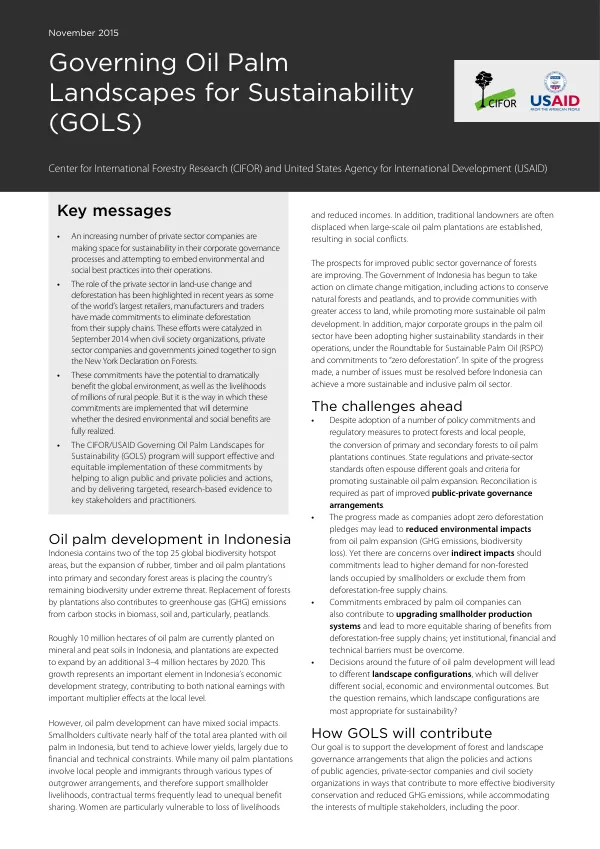
Governing Oil Palm Landscapes for Sustainability (GOLS)
The private sector's role in sustainability has been increasingly prominent in corporate governance processes, with companies attempting to embed environmental and social best practices into their operations.
2015 · 2 pages
Sign in to readA free account is required to download.
Abstract
This shift has been catalyzed by commitments from major retailers, manufacturers, and traders to eliminate deforestation from their supply chains, as exemplified by the New York Declaration on Forests signed in 2014. These commitments have the potential to significantly benefit the global environment and the livelihoods of millions of rural people. However, the implementation of these commitments is crucial in determining whether the desired environmental and social benefits are realized. The CIFOR/USAID Governing Oil Palm Landscapes for Sustainability (GOLS) program aims to support effective and equitable implementation of these commitments by aligning public and private policies and actions, and delivering targeted, research-based evidence to key stakeholders and practitioners. Indonesia, home to two of the world's top 25 biodiversity hotspots, is facing significant threats from the expansion of oil palm, rubber, and timber plantations into primary and secondary forest areas. The replacement of forests by plantations contributes to greenhouse gas emissions from carbon stocks in biomass, soil, and peatlands. Currently, roughly 10 million hectares of oil palm are planted on mineral and peat soils in Indonesia, with an additional 3-4 million hectares expected to be developed by 2020. Oil palm development can have mixed social impacts, with smallholders cultivating nearly half of the total area planted with oil palm in Indonesia. However, they tend to achieve lower yields due to financial and technical constraints. While many oil palm plantations involve local people and immigrants through outgrower arrangements, contractual terms frequently lead to unequal benefit sharing, particularly affecting women. Traditional landowners are often displaced when large-scale oil palm plantations are established, resulting in social conflicts. The prospects for improved public sector governance of forests are improving, with the Government of Indonesia taking action on climate change mitigation, including conserving natural forests and peatlands, and promoting more sustainable oil palm development. Major corporate groups in the palm oil sector have also adopted higher sustainability standards in their operations, under the Roundtable for Sustainable Palm Oil (RSPO) and commitments to "zero deforestation." Despite progress made, several issues must be resolved before Indonesia can achieve a more sustainable and inclusive palm oil sector. The challenges ahead include reconciling state regulations and private-sector standards, which often espouse different goals and criteria for promoting sustainable oil palm expansion. The adoption of zero deforestation pledges may lead to reduced environmental impacts from oil palm expansion, but concerns exist over indirect impacts on smallholders or exclusion from deforestation-free supply chains. Commitments can also contribute to upgrading smallholder production systems and lead to more equitable sharing of benefits, but institutional, financial, and technical barriers must be overcome. Decisions around the future of oil palm development will lead to different landscape configurations, delivering different social, economic, and environmental outcomes. The GOLS program aims to support the development of forest and landscape governance arrangements that align the policies and actions of public agencies, private-sector companies, and civil society organizations in ways that contribute to more effective biodiversity conservation and reduced greenhouse gas emissions, while accommodating the interests of multiple stakeholders, including the poor. The program will combine scientific research, capacity development, and stakeholder engagement at national and local levels, and will be carried out over a three-year period beginning in October 2015. Research will focus on biodiversity-rich landscapes in West and Central Kalimantan where oil palm expansion continues. The program will deliver four key components: effective governance arrangements, environmental sustainability in oil palm landscapes, socially inclusive business models, and scenarios for managing social and environmental trade-offs. Stakeholder engagement will be a critical component of the program, ensuring that the knowledge generated feeds into on-the-ground implementation and policy options for inclusive, equitable, and sustainable oil palm development. A multi-stakeholder advisory committee will support the program and help to assess the political, economic, and social contexts, identify champions, and reach target audiences. Capacity development will also be a key aspect of the program, with CIFOR-USAID Master's Degree Fellowships in the United States providing opportunities for highly qualified Indonesian candidates to study forestry conservation, natural resources management, and related disciplines.
Related documents