TETRA TECH
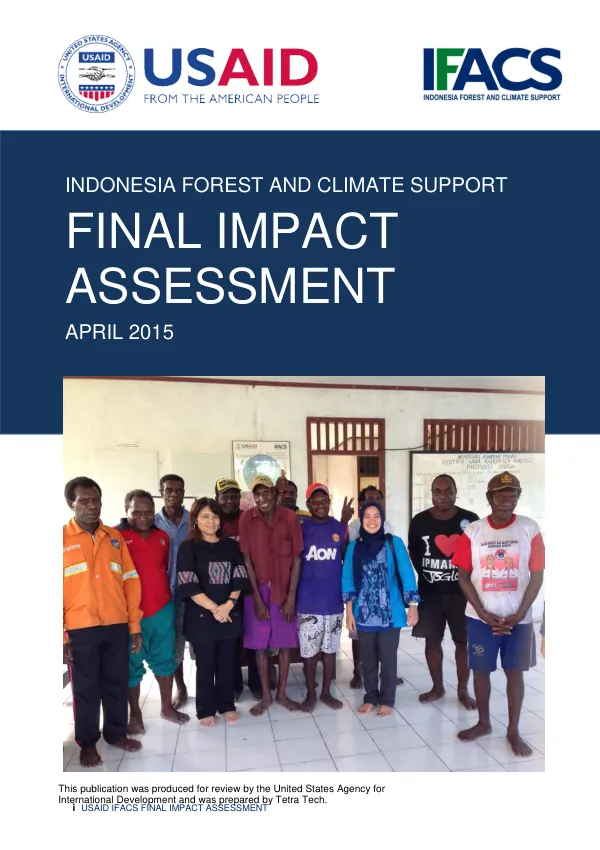
USAID IFACS FINAL IMPACT ASSESSMENT: INDONESIA FOREST AND CLIMATE SUPPORT
The Indonesia Forest and Climate Support project, implemented by the United States Agency for International Development (USAID), aimed to reduce greenhouse gas emissions and promote sustainable forest management in Indonesia.
2015 · 121 pages
Sign in to readA free account is required to download.
Abstract
The project, which began in 2009, focused on several key areas, including strategic environmental assessments, multi-stakeholder forums, community conservation and livelihood agreements, and conservation management and monitoring plans. Strategic environmental assessments (SEAs) were conducted to identify potential environmental impacts of development projects and to develop low-emissions development strategies. The assessments involved multiple stakeholders, including government agencies, civil society organizations, and local communities. The results of the SEAs were used to inform decision-making and to develop policies and regulations that promote sustainable development. Multi-stakeholder forums (MSFs) were established to bring together stakeholders from various sectors to discuss and address environmental and social issues related to forest management. The MSFs provided a platform for stakeholders to share information, build consensus, and develop collaborative solutions to address complex environmental and social challenges. Community conservation and livelihood agreements (CCLAs) were developed to promote sustainable forest management and to provide economic benefits to local communities. The CCLAs involved the establishment of protected areas, sustainable forest management practices, and the development of community-based tourism initiatives. Conservation management and monitoring plans (CMMPs) were developed to ensure the effective management and monitoring of protected areas. The CMMPs involved the establishment of monitoring systems, the development of conservation plans, and the provision of training and capacity-building programs for local communities and government agencies. The project achieved several key performance targets, including the development of SEAs and MSFs, the establishment of CCLAs and CMMPs, and the reduction of greenhouse gas emissions. The project also contributed to the development of policies and regulations that promote sustainable forest management and the protection of biodiversity. The project's findings and recommendations were presented in several supplementary reports, including a strategic environmental assessment report, a multi-stakeholder forum report, and a community conservation and livelihood agreement report. The reports provided detailed information on the project's achievements, challenges, and lessons learned. The project's impact was evaluated through a final impact assessment, which was conducted by Tetra Tech. The assessment involved the collection and analysis of data from multiple sources, including project documents, stakeholder interviews, and field observations. The assessment found that the project had achieved several key outcomes, including the reduction of greenhouse gas emissions, the promotion of sustainable forest management, and the development of policies and regulations that support sustainable development. The project's success was attributed to several factors, including the involvement of multiple stakeholders, the use of participatory approaches, and the development of collaborative solutions to address complex environmental and social challenges. The project's findings and recommendations are expected to inform future development initiatives and to contribute to the achievement of sustainable development goals in Indonesia.
Related documents