GOVERNMENT OF INDONESIA
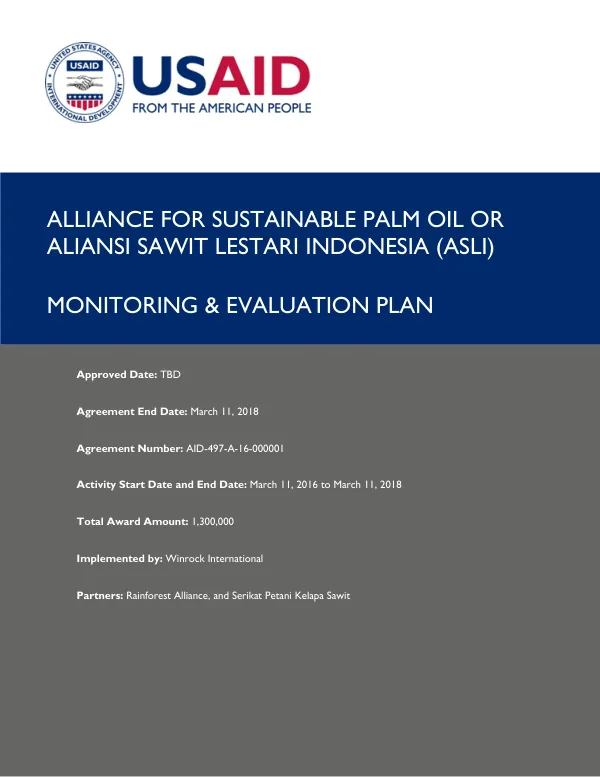
Monitoring & Evaluation Plan for Alliance for Sustainable Palm Oil (ASLI) Project
The Alliance for Sustainable Palm Oil or Aliansi Sawit Lestari Indonesia (ASLI) project is a $1.3 million Cooperative Agreement implemented by Winrock International for a total of twenty-four months.
2016 · 24 pages
Sign in to readA free account is required to download.
Abstract
ASLI is a partnership of USAID, Government of Indonesia (GOI), Winrock International, and Perkumpulan Sawit Lestari (PSL), that underpins the private sector's efforts to mitigate the impacts of climate change from deforestation and degradation in Indonesia and supports a more sustainable Indonesian palm oil sector. ASLI's primary focus is on rural farmers and smallholders. The project aims to strengthen private sector, smallholders, and GOI initiatives that address the link between deforestation and the palm oil industry. To achieve this, the project will focus on three key areas: enhanced technical research to support policy and regulatory reform, sustainability-related smallholder characteristics defined and needs assessed, and a framework for monitoring and reporting progress towards zero deforestation efforts. The project will develop a plan for informing policy and regulatory issues, provide expert scientific and technical research and analysis on priority topics to inform policy recommendations, and engage key stakeholders, GOI officials, and private sector leaders to inform policy research and analysis. Additionally, the project will engage with key partners to inform smallholder characterization, produce a detailed smallholder needs assessment report, and create an assessment for characterizing smallholders. The project will also develop key indicators on sustainable palm oil and test key performance indicators. The results framework outlines the project's objectives, including strengthened private sector, smallholders, and GOI initiatives that address the link between deforestation and the palm oil industry. The project will be implemented in Indonesia, where the oil palm industry represents both a significant threat and a significant opportunity to the realization of national development objectives. The expansion of the sector has been linked to positive impacts on smallholder incomes, as well as growth in output, income, and added value in other sectors of the economy. However, the expansion of the sector has also been a driving factor in high deforestation rates and peatland degradation across the archipelago. The Government of Indonesia (GOI) has recognized the need for increased palm oil sustainability, evidenced by the issuance of a legal standard for palm oil through its certification scheme - Indonesia Sustainable Palm Oil (ISPO). The high-level political landscape around palm oil sustainability in Indonesia has continued to change rapidly, with the GOI announcing a policy to ban peatland development and block drainage canals to raise groundwater levels. The ASLI Theory of Change is that if policy makers have access to improved technical research, and smallholders are clearly characterized, and there is a framework to monitor and verify progress towards zero deforestation efforts, then private sector, smallholders, and GOI initiatives that address the link between deforestation and the palm oil industry will be strengthened. The project will provide a platform for stakeholders to work in a more integrated manner and support the acceleration of Indonesia's palm oil transformation. Strategic programs on priority areas such as smallholder empowerment, sustainability commitment reporting framework, and support to the GOI's effort in policy and regulatory reform will be identified to improve sustainability across the sector.
Related documents