TETRA TECH
Document Preparation for SSFV Registration in Maluku
The USAID SEA Project has supported the Indonesian government in strengthening fisheries and marine resources management for sustainability through protecting and conserving biodiversity and improving the livelihood of coastal communities.
2018 · 31 pages
Sign in to readA free account is required to download.
Abstract
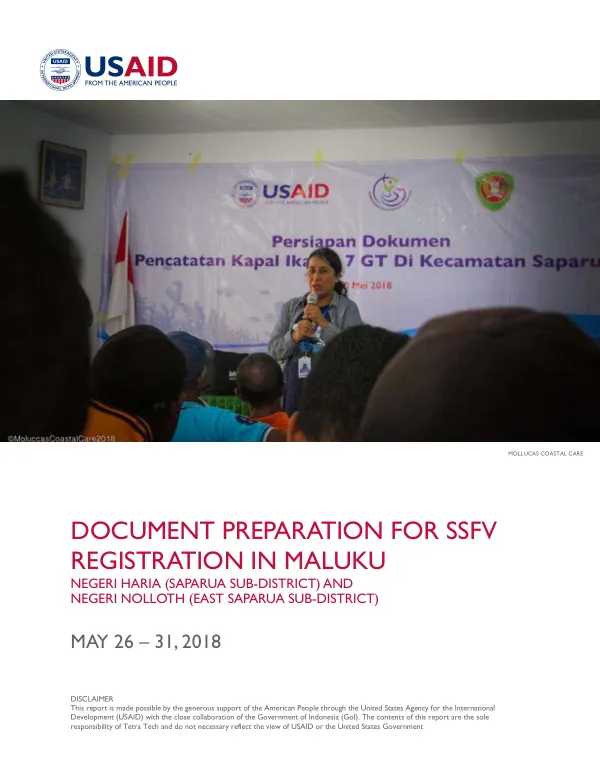
Indonesia, with its high marine biodiversity consisting of 76% coral species and 37% reef fish species, is an important country in Asia. To maintain the balance and sustainability of the ecosystem that sustains the marine biodiversity, a reliable and efficient ecosystem management is needed. Indonesia is the second-largest producer of capture fisheries globally, with a total production of 5.4 million tons in 2012. Various efforts have been undertaken by governments at national and provincial levels, and by several parties within the USAID SEA Project, which is currently working in three provinces: Maluku, North Maluku, and West Papua. The technical meeting between USAID SEA Project partners and related technical agencies concluded that documents needed for registering fishing vessels should be facilitated by the USAID SEA Project in collaboration with related institutions. The primary documents required for registering small-scale fishing vessels (SSFV) include Pas Kecil for SSFV < 7 GT or Pas Besar for SSFV > 7 GT from the Unit of Port Service of the Transportation Department, and BPKP (Bukti Pemilik Kapal Perikanan - the Letter to Proof of Owner of Fishery Ship) for SSFV < 10 GT from the Provincial Marine and Fisheries Department or DKP Provinsi. The process to obtain Pas Kecil and Pas Besar will be based on the Ministerial decree of Transportation RI Number: PM 39 of 2017 about Registration and Nationality of Vessels, and its derivative rules. The arrangement of the letter of BPKP follows the Ministerial decree of Marine Affairs and Fisheries RI Number: 11/Permen-KP/2016 concerning Minimum Service Standards for Fishing Vessels License and its derivative rules. The USAID SEA Ambon team conducted a field trip to Saparua Island in May 5-7, 2018, and found that most of the vessels were not registered. The USAID SEA Project took an initiative to support vessel registration in two villages, Haria and Nolloth, which are the most populated fishing villages in Saparua Island. Several consultations with the Head of UPP Tulehu were conducted to plan vessel measurement as a pre-condition prior to registering fishing vessels. UPP Tulehu committed to support this initiative and will delegate accredited officers for vessel measuring. The objective of this trip was to inventory fishing vessels and prepare required documents for SSFV owners in Haria and Nolloth villages. A total of 220 people participated in this activity, including local fishers, officials of the Central Maluku Fishery Office, fishery extension, USAID SEA Project, and partners (MDPI and WWF), and university students. Each party had different roles, with university postgraduate students as the main enumerators assisting fishers in providing required documents, filling forms, and preparing documents for submission to KSOP/UPP. The activity was conducted from May 26 to 30, 2018, with a detailed activity schedule shown in Table 1. The activity included community meetings and data collection in Haria and Nolloth villages, data completion in Haria and Nolloth village offices, and meetings with the Head of Sub-Districts Saparua and East Saparua. The activity successfully gathered information and documents of 158 fishing vessels, which were submitted to UPP Class II Tulehu on June 6, 2018. The activity enabled USAID SEA Project to identify 102 fishermen from Haria and 56 fishermen from Nolloth to support registering their vessels, inform for awareness building of 158 SSFV fishermen on the need and benefit to registering their fishing vessels, and inform the fishers in the PAS Kecil process. Some outputs were identified as the result from the Document Preparation for SSFV Registration in Sub-Districts Saparua and East Saparua during May 26-31, 2018, including collected required documents of 158 fishermen for submission to UPP/KSOP for boats measurement and collected required documents of 158 fishermen for submission to DKP Propinsi for BPKP. There are two important underlining achievements resulted from this activity that can lead to better management of small-scale fishing vessels: a network with relevant stakeholders for managing local fishing vessels was initiated, and collaborated participation and support from the relevant stakeholders were successfully initiated.
Related documents