USAID DEC
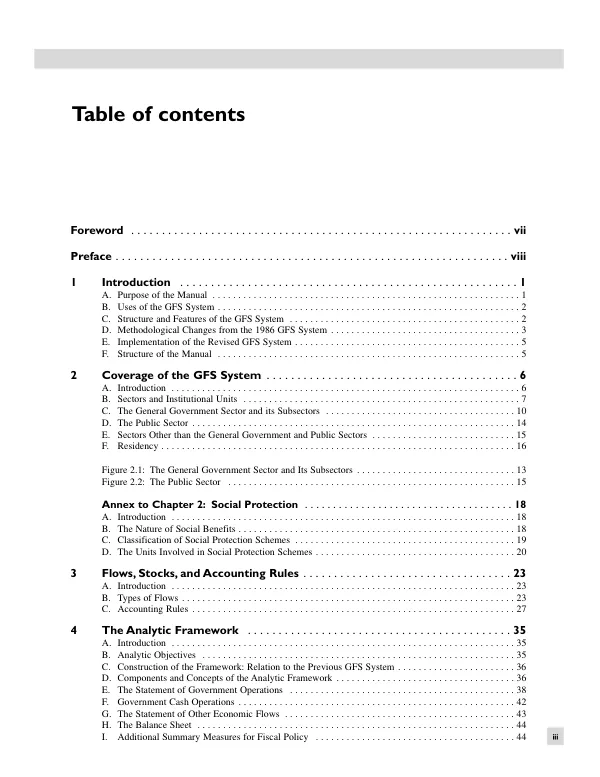
Government Finance Statistics Manual
The General Government Sector and its Subsectors is a key component of the Government Finance Statistics (GFS) system.
544 pages
Sign in to readA free account is required to download.
Abstract
The GFS system is a framework for collecting and presenting data on government finance, and it is used by countries to report their financial transactions to international organizations such as the International Monetary Fund (IMF). The General Government Sector includes all government units that are responsible for providing public goods and services, such as defense, education, and healthcare. This sector is further divided into several subsectors, including the Central Government, State Government, and Local Government. The Central Government is the highest level of government and is responsible for making national policies and decisions. It includes the executive, legislative, and judicial branches of government. The State Government is responsible for providing services and implementing policies at the state level, while the Local Government is responsible for providing services and implementing policies at the local level. The GFS system requires that countries report on the financial transactions of the General Government Sector, including revenue, expense, and net lending. Revenue includes all sources of income for the government, such as taxes, fees, and grants. Expense includes all payments made by the government, such as salaries, purchases, and transfers. Net lending is the difference between revenue and expense, and it represents the government's financial position. The GFS system also requires that countries report on the financial transactions of the Public Sector, which includes all government units that are responsible for providing public goods and services. This sector is further divided into several subsectors, including the Central Government, State Government, and Local Government. The Public Sector is responsible for providing a wide range of services, including education, healthcare, and infrastructure. The GFS system requires that countries report on the financial transactions of the Public Sector, including revenue, expense, and net lending. In addition to the General Government Sector and the Public Sector, the GFS system also requires that countries report on the financial transactions of other sectors, such as the Financial Sector and the Non-Financial Corporations Sector. The Financial Sector includes all financial institutions, such as banks and insurance companies, while the Non-Financial Corporations Sector includes all non-financial businesses and organizations. The GFS system is an important tool for governments to report on their financial transactions and to provide information to international organizations and other stakeholders. It is used by countries to report their financial data to the IMF and other international organizations, and it is also used by governments to make informed decisions about their financial policies and programs. The GFS system has undergone several changes over the years, with the most recent revision being the 2001 GFS Manual. The 2001 GFS Manual introduced several new concepts and classifications, including the concept of net lending and the classification of financial assets and liabilities. The GFS system requires that countries report on the financial transactions of the General Government Sector, including revenue