USAID DEC
Graduate Tracer Study of Human Resource for Health Management and Health Economics Programs
Sign inFEDERAL MINISTRY OF HEALTH
Graduate Tracer Study of Human Resource for Health Management and Health Economics Programs
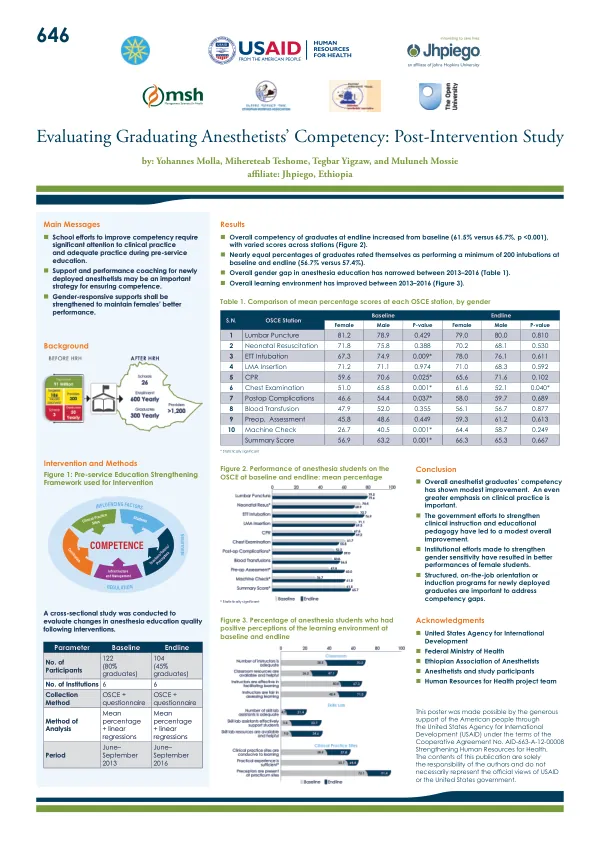
The Strengthening Human Resources for Health Project was initiated in 2014 to develop postgraduate programs in human resource for health management and health economics in four local higher education institutions in Ethiopia.
2019 · 11 pages
Sign in to readA free account is required to download.
Abstract
The project aimed to build local capacity for preparation of public health leaders and experts. The programs were designed to address the challenges faced by the health sector, including inadequate implementation capacity, lack of effective human resource motivation and retention, and weak financial management. The programs were implemented using a blended format, which consisted of face-to-face learning in higher education institutions and self-directed learning at the workplace. A total of 154 students were enrolled in successive cohorts. However, anecdotal evidence suggested problems with the training program and deployment of graduates. To address these concerns, a tracer study was conducted to understand the satisfaction of health economics and human resource for health management graduates with their education experience and current job. The study aimed to answer three specific research questions: 1) To what extent graduates' current job matches their new qualification? 2) How satisfied are graduates with the training programs? 3) What can be done to make the training programs more effective? A rapid assessment was conducted to track the first cohort of graduates from University of Gondar, Jimma University, and Addis Continental Institute of Public Health. Data was collected from December 15 to 30, 2018, using a structured questionnaire through telephone interviews and emails. The study found that 51 out of 69 first cohort graduates (74% response rate) participated in the survey. Of these, 30 were health economists (58.8%), and 21 were human resource for health management specialists. The respondents were working in various regions, including Addis Ababa, Amhara, Oromia, Tigray, and Southern Nations, Nationalities, and People's regions. Most students (72.5%) had a health background, while the remainder were from a non-health discipline. The study revealed that before joining the program, 45.1% of the respondents were working in health facilities, while 41.2% had jobs at different levels of the public health management structure. After completing the postgraduate program, the number of respondents working in health facilities dropped to 27.5%, with most of the shift occurring to teaching and research institutions, which rose from 13.7% to 29.4%. The respondents were also asked if they are currently working in departments that require their postgraduate qualification in human resource for health management or health economics. Nearly half of the respondents (52.4% of HRHM and 46.7% of health economists) said they were working in areas that don't match with their new qualification. The study found that the main reasons for not working in an area that matches their current qualification were due to low awareness and attention given by managers and the positions being already occupied by other health workers. The study concluded that the vast majority of graduates are satisfied with the training programs they received, but graduates have raised important concerns that need to be addressed to realize the full benefits of the programs. Some of the concerns are directly related to the education program, which should be discussed and addressed by organizing a curriculum review workshop. The other concern is that some of the graduates are not assigned to relevant jobs that will allow them to use their knowledge and skills maximally. This also needs discussion, and the Federal Ministry of Health and regional health bureaus should develop a monitoring mechanism to ensure value for money when new training programs are opened.