FEDERAL MINISTRY OF HEALTH
Evaluating Graduating Anesthetists’ Competency: Post-Intervention Study
Evaluating Graduating Anesthetists' Competency: Post-Intervention Study The study aimed to evaluate changes in anesthesia education quality following interventions in Ethiopia.
2016 · 1 pages
Sign in to readA free account is required to download.
Abstract
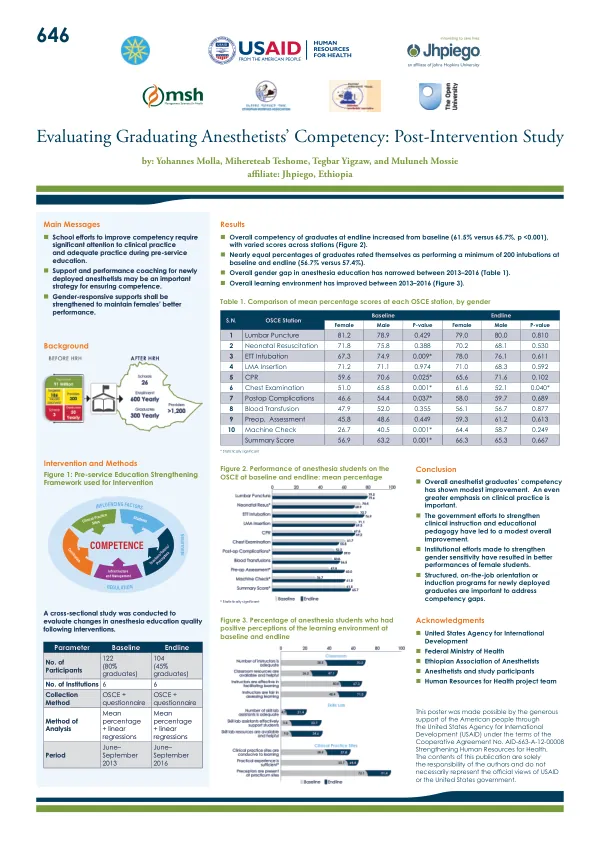
A cross-sectional study was conducted to assess the competency of graduating anesthetists. The study involved 122 participants at baseline and 104 participants at endline, with 80% and 45% of participants being graduates, respectively. The study used the Objective Structured Clinical Examination (OSCE) and a questionnaire to assess the competency of graduating anesthetists. The OSCE consisted of 10 stations, including lumbar puncture, neonatal resuscitation, ETT intubation, LMA insertion, CPR, chest examination, postop complications, blood transfusion, preop assessment, and machine check. The study found that the overall competency of graduates at endline increased from baseline, with varied scores across stations. The study also found that the overall gender gap in anesthesia education has narrowed between 2013-2016. The learning environment has improved between 2013-2016, with a significant increase in positive perceptions of the learning environment among anesthesia students. The study suggests that school efforts to improve competency require significant attention to clinical practice and adequate practice during pre-service education. Support and performance coaching for newly deployed anesthetists may be an important strategy for ensuring competence. The study also found that gender-responsive supports should be strengthened to maintain females' better performance. The government efforts to strengthen clinical instruction and educational pedagogy have led to a modest overall improvement in anesthetist graduates' competency. The study recommends that structured, on-the-job orientation or induction programs for newly deployed graduates are important to address competency gaps. The study also suggests that institutional efforts made to strengthen gender sensitivity have resulted in better performances of female students. The overall competency of graduates at endline increased from baseline, with varied scores across stations. The study used a pre-service education strengthening framework to guide the intervention. The framework consisted of several components, including clinical practice, educational pedagogy, and gender sensitivity. The study found that the framework was effective in improving the competency of graduating anesthetists. The study's results have implications for improving anesthesia education in Ethiopia. The study suggests that school efforts to improve competency require significant attention to clinical practice and adequate practice during pre-service education. The study also recommends that support and performance coaching for newly deployed anesthetists may be an important strategy for ensuring competence. The study's findings are consistent with previous research on the importance of clinical practice and educational pedagogy in improving competency. The study's results also highlight the need for institutional efforts to strengthen gender sensitivity to maintain females' better performance. The study's recommendations have implications for improving anesthesia education in Ethiopia and may be applicable to other countries with similar challenges.
Related documents