USAID DEC
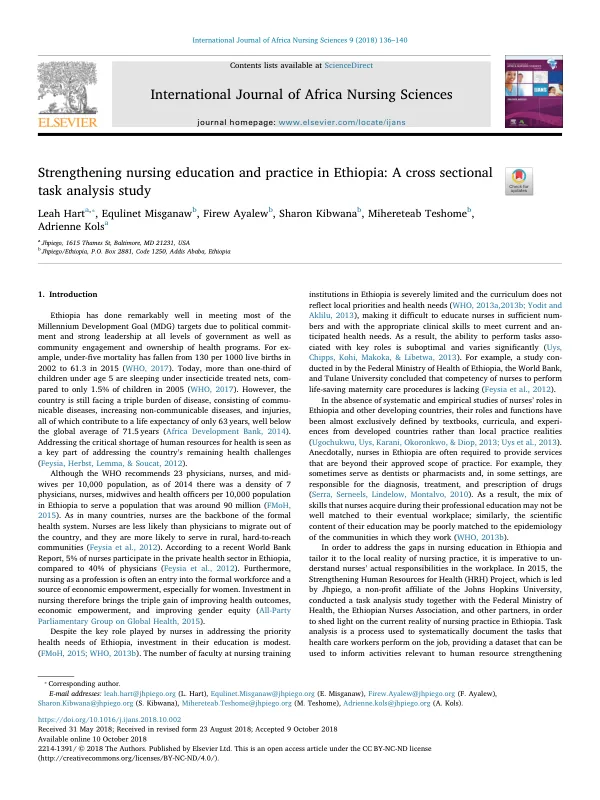
Strengthening nursing education and practice in Ethiopia: A cross sectional task analysis study
Sign inFEDERAL MINISTRY OF HEALTH
Strengthening nursing education and practice in Ethiopia: A cross sectional task analysis study
Nursing education and practice in Ethiopia have been identified as critical areas for improvement.
2018 · 5 pages
Sign in to readA free account is required to download.
Abstract
The country has made significant progress in meeting Millennium Development Goal (MDG) targets, with under-five mortality rates decreasing from 130 per 1000 live births in 2002 to 61.3 in 2015. However, Ethiopia still faces a triple burden of disease, consisting of communicable diseases, increasing non-communicable diseases, and injuries, which contributes to a life expectancy of only 63 years. The country's human resources for health are severely limited, with a density of 7 physicians, nurses, midwives, and health officers per 10,000 population in 2014. Nurses are the backbone of the formal health system in Ethiopia, and their education is critical to addressing the country's health challenges. However, investment in nursing education is modest, and the curriculum does not reflect local priorities and health needs. As a result, the ability to perform tasks associated with key roles is suboptimal and varies significantly. A task analysis study was conducted in 2015 to shed light on the current reality of nursing practice in Ethiopia. The study aimed to inform project activities to strengthen nursing education and practice in the country. A descriptive, survey-based study design was used to collect information on tasks performed by nurses working in public health facilities in rural and urban areas of all eleven regional states of Ethiopia. The study sample consisted of 224 nurses who were relatively newly deployed, with a response rate of 99.5%. The study tool, including the task list, was developed by a group of local experts, including nursing faculty instructors, clinical preceptors, and senior nurse members of the Ethiopian Nurse Association. The task list was drafted based on the nursing curriculum, nursing scope of practice, and nurses' job descriptions in Ethiopia. An additional group of nursing experts reviewed and revised the task list to ensure its accuracy and relevance. The task analysis study aimed to identify and address practice gaps for nurses in Ethiopia. The study's findings will inform project activities to strengthen nursing education and practice in the country. The study's results will also contribute to the development of a more effective and efficient nursing education system in Ethiopia, which will ultimately improve the quality of care provided to patients.
Related documents