USAID DEC
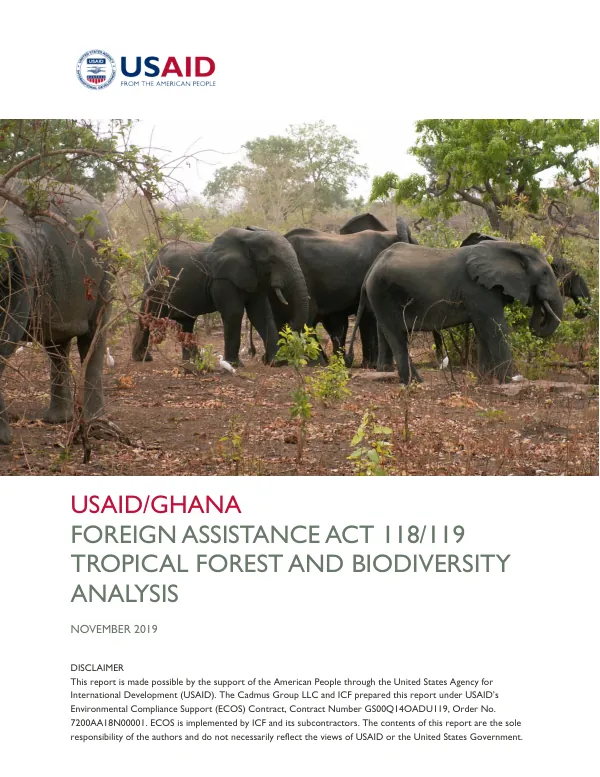
USAID/GHANA Foreign Assistance Act 118/119 Tropical Forest and Biodiversity Analysis
Sign inICF
USAID/GHANA Foreign Assistance Act 118/119 Tropical Forest and Biodiversity Analysis
Tropical forests and biodiversity in Ghana face significant threats, including deforestation, habitat fragmentation, and climate change.
2019 · 175 pages
Sign in to readA free account is required to download.
Abstract
The country's tropical forests cover approximately 1.8 million hectares, with the majority located in the southern region. Ghana's biodiversity is characterized by a rich array of flora and fauna, including over 3,000 plant species and 750 bird species. The main ecosystem types in Ghana include tropical rainforests, savannas, and mangrove forests. The country's forest type, status, and associated biodiversity are critical components of its natural heritage. Ghana's forests are home to a diverse range of species, including primates, antelopes, and elephants. The country's species diversity and status are also of significant concern, with many species facing threats from habitat loss and fragmentation. Ghana's genetic diversity is also an important aspect of its natural heritage. The country's forests are home to a wide range of plant and animal species, many of which are found nowhere else in the world. The status and management of protected areas in Ghana are also critical components of the country's conservation efforts. Ghana has established several protected areas, including national parks and wildlife sanctuaries, to conserve its natural resources. The value and economic potential of Ghana's biodiversity are significant. The country's forests provide a range of ecosystem goods and services, including timber, fuelwood, and non-timber forest products. The economic potential of Ghana's biodiversity is also substantial, with the country's forests and wildlife generating significant revenue from tourism and other activities. Ghana's legal framework and institutional structure affecting conservation and natural resource management are critical components of the country's conservation efforts. The country has established several laws and policies to protect its natural resources, including the Forest and Wildlife Conservation Act and the Environmental Protection Agency Act. Ghana has also ratified several international agreements, including the Convention on International Trade in Endangered Species of Wild Fauna and Flora and the Convention on Biological Diversity. Threats to tropical forestry and biodiversity in Ghana are significant and include direct threats such as deforestation and habitat fragmentation, as well as indirect threats such as climate change and population growth. The country's direct threats to biodiversity include the loss of habitat and the decline of species populations. The indirect threats to biodiversity in Ghana include climate change, which is altering the country's ecosystems and threatening the survival of many species. To conserve Ghana's tropical forests and biodiversity, several actions are necessary. These include the establishment of protected areas, the development of sustainable forest management practices, and the implementation of policies to reduce deforestation and habitat fragmentation. The country must also address the indirect threats to biodiversity, including climate change and population growth. This can be achieved through the development of sustainable land-use planning practices and the implementation of policies to reduce greenhouse gas emissions. The Ghana Forest Investment Program (GFIP) is a key initiative aimed at promoting sustainable forest management and reducing deforestation in the country. The program is implemented by the Forestry Commission and aims to promote the development of sustainable forest management practices, reduce deforestation, and improve the livelihoods of forest-dependent communities. The GFIP also aims to promote the development of forest-based industries, such as timber and non-timber forest products, and to improve the management of forest resources. The Sustainable Land and Water Management Program (SLWMP) is another key initiative aimed at promoting sustainable land-use planning and reducing deforestation in Ghana. The program is implemented by the Ministry of Food and Agriculture and aims to promote the development of sustainable land-use planning practices, reduce deforestation, and improve the livelihoods of rural communities. The SLWMP also aims to promote the development of sustainable agriculture practices and to improve the management of water resources. In conclusion, Ghana's tropical forests and biodiversity face significant threats, including deforestation, habitat fragmentation, and climate change. To conserve the country's natural heritage, several actions are necessary, including the establishment of protected areas, the development of sustainable forest management practices, and the implementation of policies to reduce deforestation and habitat fragmentation. The Ghana Forest Investment Program and the Sustainable Land and Water Management Program are key initiatives aimed at promoting sustainable forest management and reducing deforestation in the country.
![Relationship Context of First Sex - Agency, Consent, and Coercion: Young People's Experiences of First Sex in Ashanti and Northern Regions, Ghana (QRS24) - Analysis Brief [AB35]](https://covers.devme.ai/gen/145286.webp)