USAID DEC
USAID's Tenure and Global Climate Change (TGCC) Program in Ghana: Securing Land and Tree Rights for Sustainable Cocoa Cultivation
Sign inUSAID
USAID's Tenure and Global Climate Change (TGCC) Program in Ghana: Securing Land and Tree Rights for Sustainable Cocoa Cultivation
Ghana's cocoa landscape is characterized by low productivity and deforestation.
2018 · 2 pages
Sign in to readA free account is required to download.
Abstract
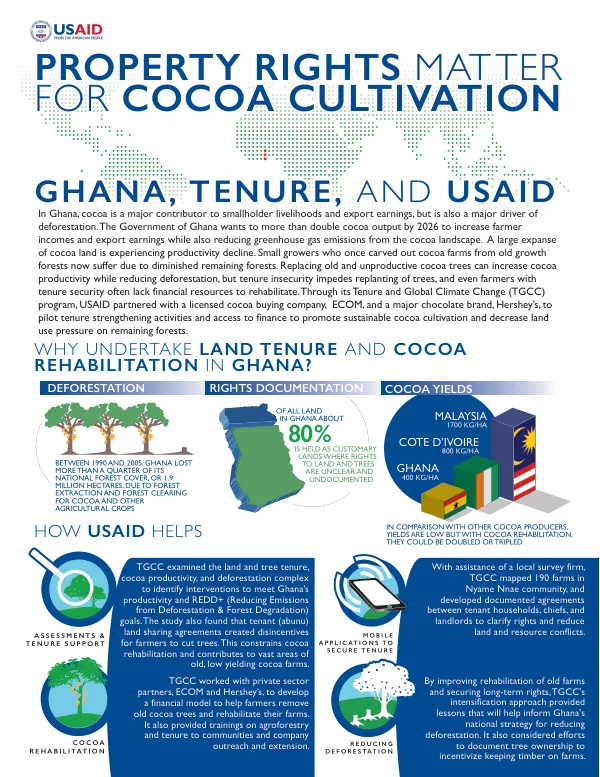
The country has lost over a quarter of its national forest cover, or 1.9 million hectares, due to forest extraction and forest clearing for cocoa and other agricultural crops. Ghana's cocoa yields are low, averaging 400 kg/ha, compared to other major cocoa producers such as Côte d'Ivoire, which averages 800 kg/ha, and Malaysia, which averages 1,700 kg/ha. The Government of Ghana aims to more than double cocoa output by 2026 to increase farmer incomes and export earnings while reducing greenhouse gas emissions from the cocoa landscape. However, tenure insecurity impedes cocoa rehabilitation and replanting of trees, and even farmers with tenure security often lack financial resources to rehabilitate. Through its Tenure and Global Climate Change (TGCC) program, USAID partnered with a local survey firm to map 190 farms in the Nyame Nnae community and develop documented agreements between tenant households, chiefs, and landlords to reduce land and resource conflicts. The TGCC program also worked with private sector partners, ECOM and Hershey's, to develop a financial model to support sustainable cocoa cultivation and reduce land use pressure on forests. The program provided trainings on agroforestry and tenure to communities and company outreach and extension. A local survey firm carried out land surveying and documentation, while the Forestry Commission supported tree documentation for REDD+ and the World Cocoa Foundation spearheaded Cocoa Action and addressed cocoa productivity constraints. The TGCC program helped national government, Ghana's Forestry Commission, Cocobod, and the World Cocoa Foundation to pilot land, tree, and tree interventions, and to share lessons learned to build momentum for broader integration of tenure rights into future work. The program also supported ECOM, a local cocoa buying company, to refine its financing model to support sustainable cocoa cultivation and reduce land use pressure on forests. Hershey's, a major chocolate brand, supported sustainable cocoa, farmer extension, and tenure reforms. Securing land and tree rights is a critical component of the TGCC program. The program provided alternative dispute resolution tools and training to help chiefs, farmers, landowners, and extension workers resolve conflicts that arose during the adjudication of rights. The program also supported the development of a financial model to support sustainable cocoa cultivation and reduce land use pressure on forests. The program's tenure analysis allowed ECOM to understand why many farmers had earlier financing offers. The TGCC program also focused on extension and providing farmers with the technical skills to succeed. Ghana is now moving away from sun cocoa to an agroforestry shaded intercrop approach. The program broadened the skills of ECOM staff so they are better equipped to extend rehabilitation techniques to their member farmers. The program also supported the development of a financial model to support sustainable cocoa cultivation and reduce land use pressure on forests. The TGCC program has made significant progress in securing land and tree rights and promoting sustainable cocoa cultivation in Ghana. The program has helped to reduce land and resource conflicts and has increased cocoa productivity. The program's success has also helped to inform Ghana's national strategy for reducing deforestation and promoting sustainable cocoa cultivation.