FOOD AND AGRICULTURE ORGANIZATION OF THE UNITED NATIONS IN GEORGIA
Greenhouse Gas Emissions in Madagascar
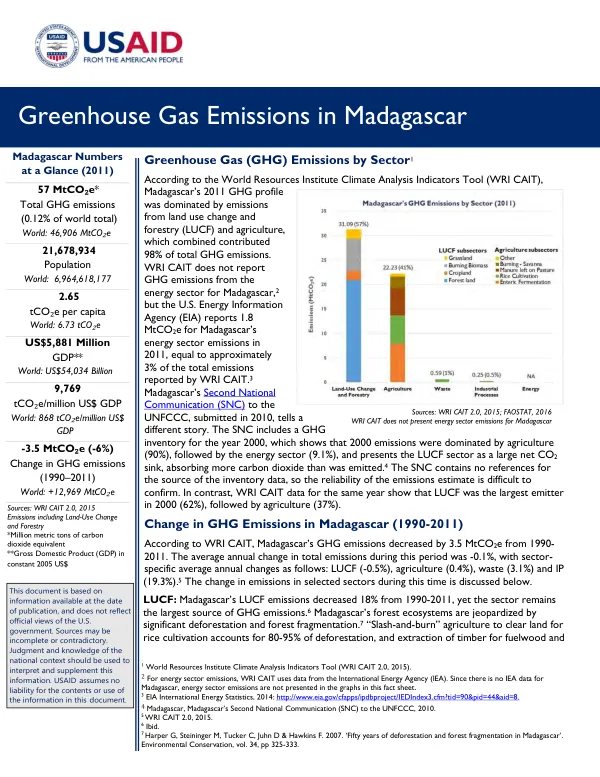
Madagascar's 2011 Greenhouse Gas (GHG) profile was dominated by emissions from land use change and forestry (LUCF) and agriculture, which combined contributed 98% of total GHG emissions.
2016 · 2 pages
Sign in to readA free account is required to download.
Abstract
The World Resources Institute Climate Analysis Indicators Tool (WRI CAIT) reports that LUCF accounted for 62% of total emissions in 2000, followed by agriculture at 37%. In contrast, the Second National Communication (SNC) to the UNFCCC, submitted in 2010, shows that agriculture dominated emissions in 2000, accounting for 90% of total emissions. Madagascar's GHG emissions decreased by 3.5 MtCO2e from 1990-2011, with an average annual change of -0.1%. The LUCF sector decreased by 18% during this period, yet remains the largest source of GHG emissions. Deforestation and forest fragmentation are significant threats to Madagascar's forest ecosystems, with "slash-and-burn" agriculture to clear land for rice cultivation accounting for 80-95% of deforestation. Annual deforestation rates decreased from an average of 0.8% from 1990-2000 to an average of 0.5% from 2000-2005. Madagascar's agriculture emissions grew 4.3% from 1990-2011, driven by rice cultivation. Total rice production more than doubled from 2.5 million tons to 4.7 million tons between 2000 and 2010. To mitigate this trend, Madagascar promoted crop diversification and seasonal rotation of crops, and encouraged farmers to improve seeds, agricultural practices, and techniques. Livestock also contribute to Madagascar's agriculture emissions, although enteric fermentation and manure left on pasture declined 1.8% and 0.3% respectively between 1990 and 2011. Madagascar's energy sector emissions increased by 63% from 0.96 MtCO2e in 1990 to 1.84 MtCO2e in 2011. The energy industries subsector accounted for 34% of energy emissions in 2000, making it the largest contributor to the sector's GHG emissions. The electricity access rate in Madagascar is very low, estimated at 12% in 2013, and the electricity available is carbon intensive, with 67% of power generated by diesel fuel. Transportation accounted for 32% of energy sector emissions in 2011, exacerbated by Madagascar's aging vehicle fleet, hilly terrain, and low travel speeds. Madagascar's GHG emissions decreased 6% from 1990 to 2011, averaging -0.1% annually, while GDP grew by 55%, averaging 2.2% annually. Political crises in 2002 and 2009 caused large GDP contractions of 14.9% and 6.6%, respectively. Madagascar's key development challenge is to accelerate economic growth, yet there is potential to also reduce GHG emissions from GHG-intensive activities. Madagascar's Intended Nationally Determined Contribution (INDC) aims to reduce its GHG emissions by 14% by 2030 compared to a Business as Usual (BAU) scenario, conditioned on financial support from the international community. Proposed mitigation actions include reforestation, enhanced forest and grassland monitoring, climate-smart rice farming techniques, increased hydropower and solar energy, sustainable cookstoves, and energy efficiency.
Related documents