CENTER FOR INTERNATIONAL FORESTRY AND RESEARCH
Greenhouse Gas Emissions by Sector in Ethiopia
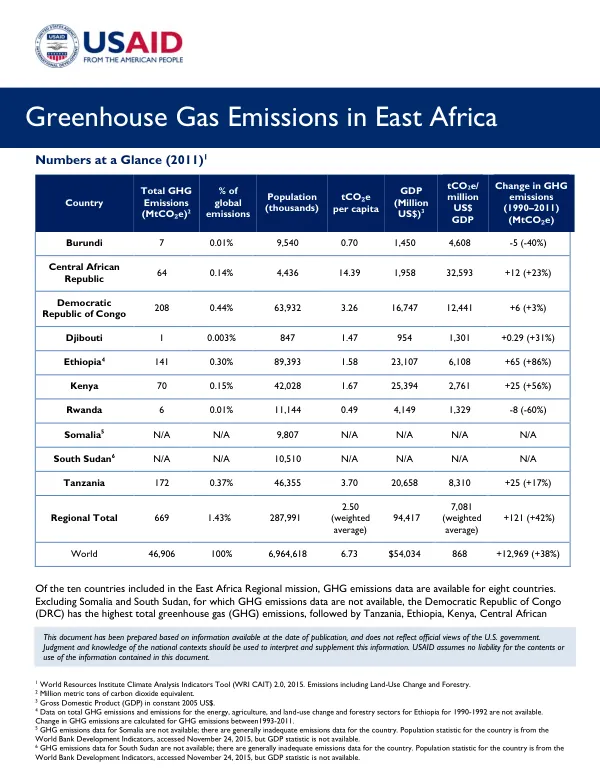
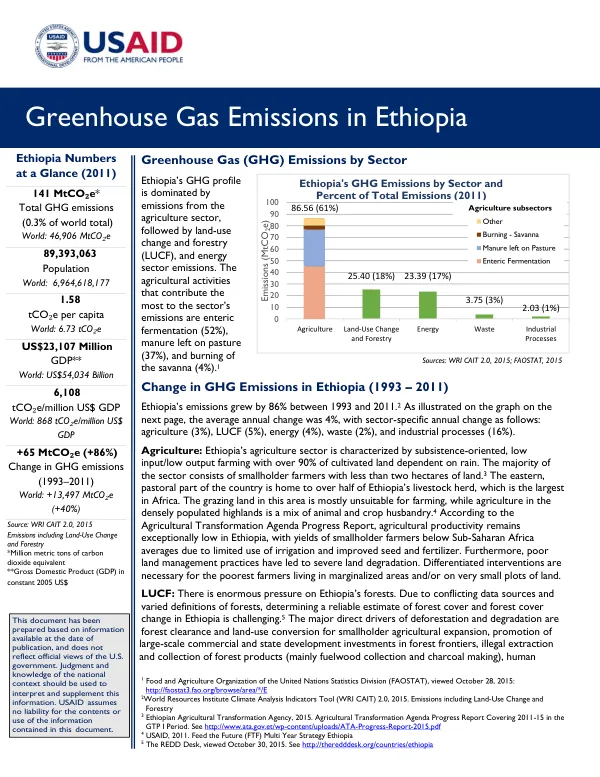
Ethiopia's Greenhouse Gas (GHG) profile is dominated by emissions from the agriculture sector, followed by land-use change and forestry (LUCF), and energy sector emissions.
2015 · 2 pages
Sign in to readA free account is required to download.
Abstract
The agricultural activities that contribute the most to the sector's emissions are enteric fermentation (52%), manure left on pasture (37%), and burning of the savanna (4%). The country's GHG emissions grew by 86% between 1993 and 2011, with an average annual change of 4%. Sector-specific annual change was as follows: agriculture (3%), LUCF (5%), energy (4%), waste (2%), and industrial processes (16%). Agriculture is characterized by subsistence-oriented, low input/low output farming with over 90% of cultivated land dependent on rain. The majority of the sector consists of smallholder farmers with less than two hectares of land. Implementation of differentiated interventions is necessary for the poorest farmers living in marginalized areas and/or on very small plots of land. LUCF is a significant concern in Ethiopia, with enormous pressure on the country's forests. The major direct drivers of deforestation and degradation are forest clearance and land-use conversion for smallholder agricultural expansion, promotion of large-scale commercial and state development investments in forest frontiers, illegal extraction and collection of forest products, human settlement in forest areas, forest fires, and development of infrastructure and road networks. The energy sector in Ethiopia has seen significant growth, with total primary energy supply more than doubling from 1990 to 2012. Biofuels and waste accounted for 93% of energy supply in 2012, followed by fossil fuels with 6%, and 1% from renewables. The electric grid system consists almost entirely of renewable energy, nearly all from hydropower, with wind and geothermal. Ethiopia aims to develop biogas and reduce the demand for fuel wood by promoting efficient cook stoves. The country's carbon intensity has decreased relative to 1991, indicating that the economy has decoupled from natural resource consumption and GHG emissions. The Climate Resilient Green Economy (CRGE) strategy aims to achieve carbon-neutral growth and middle-income status before 2025, which will require increasing agricultural productivity, encouraging sustainable land use, building an industrial base, and fostering export growth and diversification. In its Intended Nationally Determined Contribution (INDC), Ethiopia pledges to cap its 2030 GHG emissions at 145 MtCO2e, which equates to a 64% (255 MtCO2e) reduction from projected business-as-usual emission levels in 2030. The reduction includes 90 MtCO2e from agriculture, 130 MtCO2e from forestry, 20 MtCO2e from industry, 10 MtCO2e from transport, and 5 MtCO2e from buildings.