GEORGETOWN UNIVERSITY
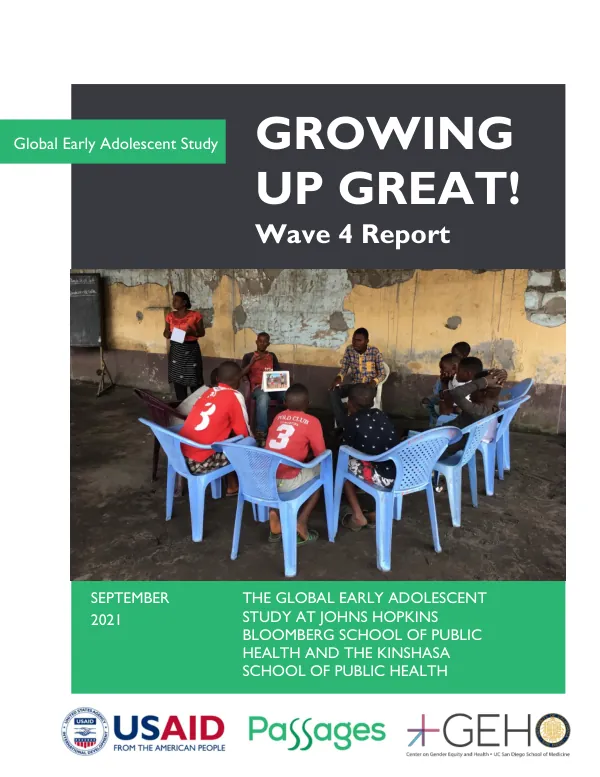
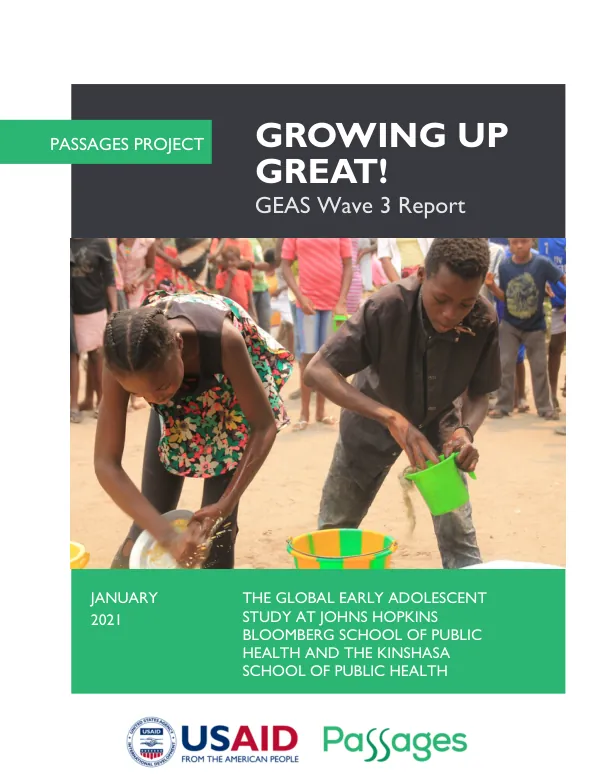
Growing Up Great! GEAS Wave 3 Report
The Global Early Adolescent Study (GEAS) is a longitudinal study that aims to understand the experiences and challenges faced by early adolescents in various settings.
2021 · 97 pages
Sign in to readA free account is required to download.
Abstract
The study is conducted by the Johns Hopkins Bloomberg School of Public Health and the Kinshasa School of Public Health, with input from the Institute for Reproductive Health at Georgetown University and Save the Children. The study is funded by the USAID-funded Passages Project, which is supported by the American people through the United States Agency for International Development (USAID) and the Bill & Melinda Gates Foundation. The GEAS study focuses on the experiences of early adolescents, aged 10-14 years, in various settings, including schools, communities, and households. The study uses a mixed-methods approach, combining both quantitative and qualitative data collection methods. The study population is selected based on eligibility criteria, including age, sex, and geographic location. The study design involves a longitudinal study, with data collection at multiple waves. The first wave of data collection was conducted in 2018, and subsequent waves were conducted in 2020 and 2021. The study population is divided into two groups: a control group and an intervention group. The control group consists of early adolescents who did not receive any interventions, while the intervention group received various activities and programs aimed at promoting their health and well-being. The study results show that early adolescents in the control group faced various challenges, including limited access to education, poor health outcomes, and exposure to violence and bullying. The study also found that early adolescents in the control group had limited knowledge about sexual and reproductive health, and that they were more likely to experience mental health problems. In contrast, early adolescents in the intervention group showed significant improvements in various outcomes, including education, health, and well-being. The study found that the intervention group had higher levels of knowledge about sexual and reproductive health, and that they were less likely to experience mental health problems. The study also found that the intervention group had better relationships with their peers and family members, and that they were more likely to engage in healthy behaviors. The study results suggest that the GEAS intervention was effective in promoting the health and well-being of early adolescents. The study found that the intervention group had significant improvements in various outcomes, including education, health, and well-being. The study also found that the intervention group had better relationships with their peers and family members, and that they were more likely to engage in healthy behaviors. The study's findings have implications for the development of interventions aimed at promoting the health and well-being of early adolescents. The study suggests that interventions that focus on education, health, and social relationships can be effective in promoting the well-being of early adolescents. The study also highlights the importance of addressing the social and cultural context in which early adolescents live, and of involving community members and stakeholders in the development and implementation of interventions. The study's results also have implications for policy and programming. The study suggests that governments and organizations should prioritize the development of interventions aimed at promoting the health and well-being of early adolescents. The study also highlights the importance of addressing the social and cultural context in which early adolescents live, and of involving community members and stakeholders in the development and implementation of interventions. Overall, the GEAS study provides valuable insights into the experiences and challenges faced by early adolescents in various settings. The study's findings have implications for the development of interventions aimed at promoting the health and well-being of early adolescents, and highlight the importance of addressing the social and cultural context in which they live.