INTERNATIONAL HEALTH AND DEVELOPMENT ASSOCIATES
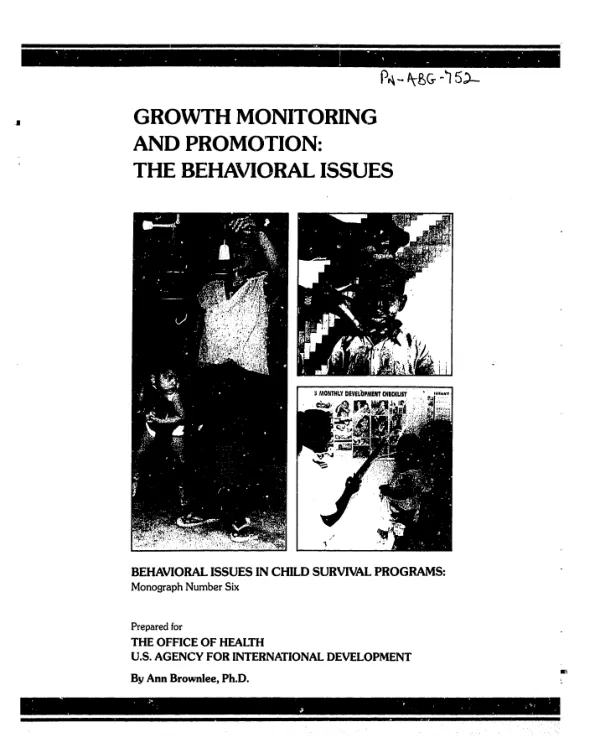
Growth monitoring and promotion : the behavioral issues
Despite its potential for reducing infant mortality, growth monitoring and promotion (GM/P) has been very difficult to implement due to the need for active involvement of mothers, health workers, and the community in its implementation.
Brownlee, Ann · 1990
Sign in to readA free account is required to download.
Abstract
This monograph, the sixth in a series, examines key behavioral aspects of GM/P. Topics include: (l) local beliefs and practices concerning infant and child growth; (2) health workers" beliefs and practices affecting GM/P project development; (3) strategies for promoting effective individual and community participation; (4) design of GM/P technology that takes account of behavioral findings; (5) behavioral aspects of promotional and follow-up activities; (6) expanding and sustaining effective GM/P projects; and (7) methods for studying behavior related to GM/P. Major conclusions and recommendations are as follows. (1) Planners should explore traditional measures for measuring growth, as well as practices with particularly negative or positive effects on growth. They should also be sensitive to local attitudes towards weighing children and, more generally, should adopt innovative and culturally appropriate techniques for including the community in the entire GM/P process. (2) The use of protocols providing health workers with specific guidelines should be considered. (3) Growth charts should be simple and clear, use culturally appropriate colors and language, and have specific technical features which facilitate accurate plotting and interpretation. (4) Key attributes of a scale suitable for field use include maintenance, durability, portability, acceptability, accuracy, potential for user error, simplicity, and cost. (5) Planners should focus maximum effort on identifying and strengthening the weakest link in the GM/P process. (6) All GM/P projects should have an educational component which provides mothers with practical advice for activity between GM/P sessions. (7) Supplementary feeding, when deemed necessary, should focus on high-risk children aged 0-3 and be kept separate from GM/P activities.