USAID DEC
Guatemala Landscape Analysis: Integrating Gender and Nutrition within Agricultural Extension Services
Sign inFOOD AND AGRICULTURE ORGANIZATION OF THE UNITED NATIONS IN GEORGIA
Guatemala Landscape Analysis: Integrating Gender and Nutrition within Agricultural Extension Services
The agricultural sector in Guatemala faces significant challenges, including poorly established land rights, which affect growth potential.
2016 · 29 pages
Sign in to readA free account is required to download.
Abstract
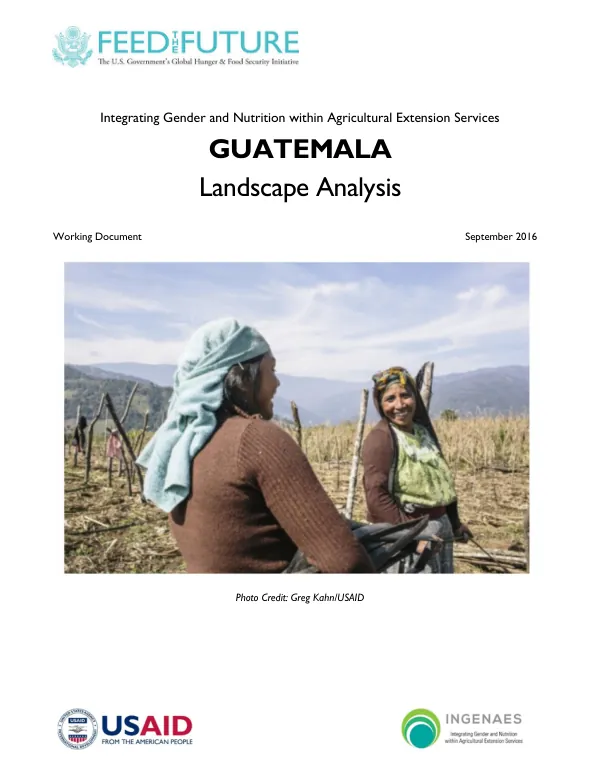
The country's agricultural sector is characterized by a high level of informality, with many farmers lacking secure access to land. This has led to a lack of investment in agricultural development, as farmers are hesitant to invest in land that they do not own. The national extension system in Guatemala is relatively new and is still in the process of being established. The Ministry of Agriculture, Livestock and Food (MAGA) is responsible for overseeing the extension system, which includes the National Agricultural Extension System (SNEA). The SNEA is responsible for providing technical assistance and advisory services to farmers, but it faces significant challenges, including a lack of resources and inadequate infrastructure. The Feed the Future initiative is a key player in the agricultural sector in Guatemala, with a focus on reducing global hunger and food insecurity. The initiative is led by the United States Agency for International Development (USAID) and includes a number of partner organizations. The initiative's Multi-Year Strategy for 2011-2015 outlines a number of goals, including increasing agricultural productivity, improving nutritional outcomes, and reducing poverty. The Western Highlands region of Guatemala is a key focus area for the Feed the Future initiative, with a high concentration of indigenous populations. The region faces significant challenges, including poverty, malnutrition, and limited access to agricultural inputs and services. The USAID-led Western Highlands Integrated Program (WHIP) is a key initiative in the region, with a focus on improving agricultural productivity and reducing poverty. The INGENAES project is designed to strengthen the efforts of the Feed the Future initiative in Guatemala, with a focus on integrating gender and nutrition into agricultural extension services. The project aims to improve the capacity of key stakeholders, including farmers, producer groups, cooperatives, policy makers, technical specialists, development NGO practitioners, and donors. The project will focus on changes in institutions that directly impact men and women who access agricultural information, training, technologies, and nutrition information. The INGENAES project will address four main gaps in extension services in terms of gender and nutrition integration. These gaps include: building more robust, gender-responsive, and nutrition-sensitive institutions, projects, and programs; identifying and scaling proven mechanisms for delivering improved EAS to women farmers; disseminating technologies that improve women's agricultural productivity and increase household nutrition; and applying effective, nutrition-sensitive, extension approaches and tools for engaging both men and women. The project will undertake a number of indicative activities, including learning exchanges, assessments, curricula development, training into action, mentoring relationships, internship experiences, and networks that focus on identifying gender-responsive and nutrition-sensitive innovations that can be promoted by EAS organizations, and adopted by men and women farmers. Developing these outputs collaboratively with agricultural extension experts and other partners will transform extension-relevant institutions working directly with men and women farmers. The INGENAES project will focus on the Western Highlands region of Guatemala, where indigenous populations are the majority. The project will pay specific attention to the indigenous population of the Western Highlands and to the women of those communities. A 2013 baseline survey was conducted in the WHIP Zone of Influence (ZOI) to help determine the impact of WHIP projects. The data collected is particularly relevant to those intending to work in the Western Highlands and, as such, is frequently referenced in this report. The project's efforts will strengthen the capacity of key stakeholders and provide the fora and networks for them to coordinate and reach agreement on policies and strategies to implement improved EAS that better meet the needs of men and women farmers. Improved services will empower women and engage men, leading to increased agricultural productivity, improved nutritional outcomes, reduced poverty, and achieved gender equity.
Related documents