USAID
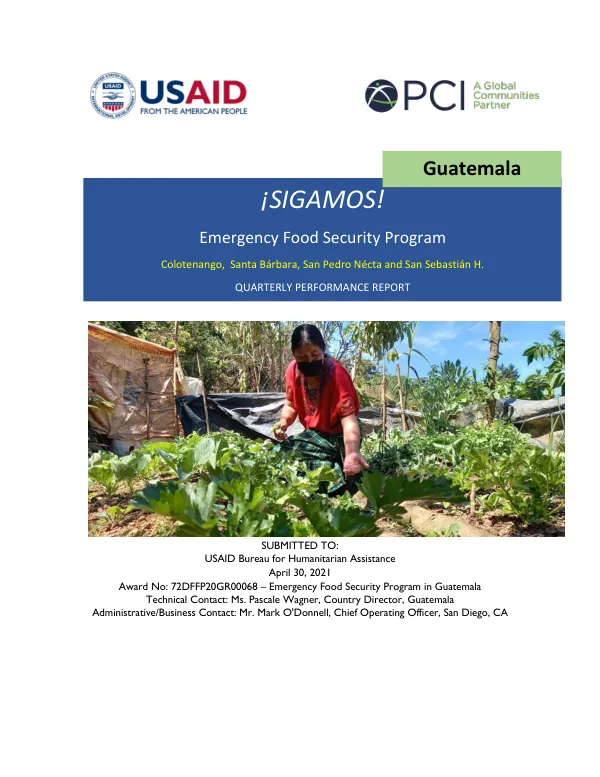
PCI Guatemala, ¡Sigamos! Quarterly Report January 1, 2021 – March 31, 2021
The ¡Sigamos!
2021 · 11 pages
Sign in to readA free account is required to download.
Abstract
Project, implemented by PCI Guatemala, aims to reduce short-term hunger and childhood morbidity in vulnerable households of the western dry corridor of Guatemala. The program's objective is to cover 6,400 vulnerable families in 55 communities of the municipalities of Colotenango, Santa Bárbara, San Pedro Nécta, and San Sebastián H. of the Department of Huehuetenango. During the quarter from January to March 2021, the program assisted 6,515 households who received $1,245,790 in cash transfers. Within these households, the program reached 3,923 children under five and 135 pregnant women. Field staff conducted 647 household visits, prioritizing those with children with acute severe or moderate malnutrition and those with serious illnesses, for referral, health, and nutrition counseling. The program registered 1,430 volunteers into the Health Brigades and groups of Men and Women Who Keep On! (¡SIGUEN!). These groups play an important role in community organization and mobilization and replication of trainings on health and nutrition topics with the participating families. To date, a total of 20 Women Empowered (WE) groups have been established with a membership of 284, surpassing the target by two groups and 104 members. The groups have a cumulative savings of $10,455 and have given out 11 loans for a total of $777.00. Increased access to nutritious food is a key objective of the ¡Sigamos! Project. Participant households received three tranches of cash transfers, totaling $1,245,790, which will improve household access to nutritious foods, mainly basic grains such as corn and beans, as well as meats, vegetables, and fruits. The increased access to food will improve food availability and consumption and therefore food security. Sensitization sessions were conducted for participant households to orient them on spending more on nutritious food and needed basic household items. Data from post-transfer surveys indicates that most households use 35% of the cash to buy basic grains (corn and beans), 21% for groceries, 7% for meat, vegetables, and fruits, and the remaining 37% for transportation costs, payment of debts, and purchase of medicines. Among participant households, some have established family gardens, poultry farms, raising animals for fattening, and production of oyster mushrooms. This enables them to have access to and availability of foods for consumption. The program has also improved the availability of animal protein in the family diet, by means of the production of meat and eggs, which has become an important source of food at the family level in the difficult months. One of the main challenges related to expanding coverage of productive activities is poor water supply, especially for uses beyond family consumption. The program has been able to support families with seeds through coordination with private enterprises and government entities. Improving healthcare, nutrition, and hygiene behaviors is another key objective of the ¡Sigamos! Project. The program continues efforts to improve the health and nutrition of all members of the participant families, especially for the children under five who have been screened monthly and observed for signs and evaluated for malnutrition using Mid-Upper Arm Circumference (MUAC). With this tool, children were monitored, and nine new cases of Severe Malnutrition (SAM) were identified. The families of children who were found to have any nutritional issues were referred to health services for care, control, and treatment. The program has also registered 151 families who participated in the six program activities on a demonstration basis, so that other families can learn and replicate the productive activities when the rainy season begins in May. The program has been able to support families with seeds through coordination with private enterprises and government entities.
Related documents