USAID DEC
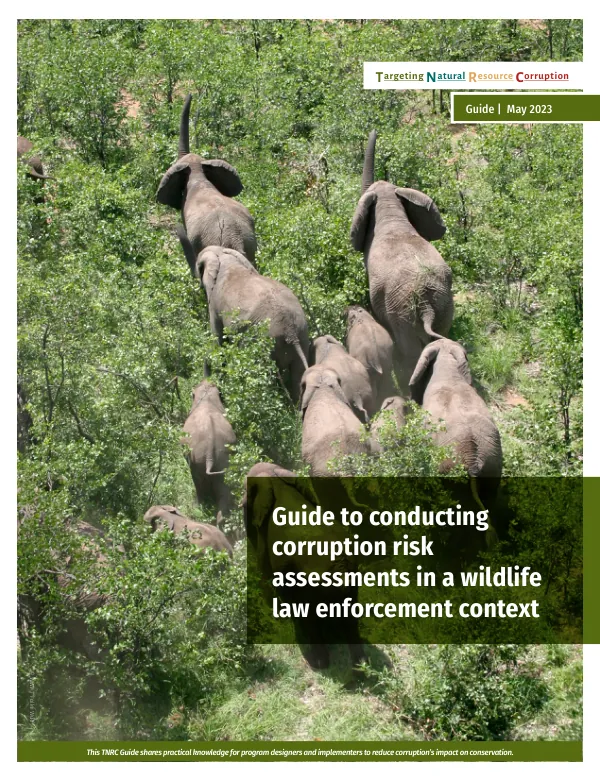
Guide to conducting corruption risk assessments in a wildlife law enforcement context
Sign inUSAID
Guide to conducting corruption risk assessments in a wildlife law enforcement context
Corruption risks in law enforcement agencies responsible for protecting wildlife, fisheries, and forests pose significant threats to biodiversity outcomes.
2023 · 26 pages
Sign in to readA free account is required to download.
Abstract
These risks can hinder the ability to detect, investigate, prosecute, and sanction crimes and corruption involving natural resources. A corruption risk assessment (CRA) is an essential tool in addressing these risks, providing a systematic way to identify, prioritize, and mitigate significant corruption risks in a given context. A CRA can help answer critical questions, including what, where, how, and how severe the main corruption risks are in law enforcement processes, and what can be done to mitigate these risks and improve the functioning of the law enforcement system in support of conservation and natural resource management. Specifically, a CRA can support partner agencies in assessing and improving their operational procedures, probing weaknesses, loopholes, or gaps that could be abused by corrupt officers, and identifying risk mitigation measures. The Map, Characterize, Assess, and Recommend (MCAR) approach, designed by the Basel Institute, is a structured method for conducting a CRA in a conservation law enforcement context. This approach is particularly suited to law enforcement, which involves a multiplicity of actors and often overlapping roles. The MCAR method looks at the entire system of investigations and prosecutions, including those covering natural resource management. Several methods for conducting a CRA exist, including the UNDCC Scaling Back Corruption guide for addressing corruption risks in wildlife management authorities. However, the MCAR method is specifically designed to assess corruption risks in law enforcement and criminal justice, including those covering natural resource management. This approach is special in that it focuses on the entire system of investigations and prosecutions, making it particularly suited to law enforcement. The MCAR process involves several key steps, including preparing and launching the assessment, engaging with participants and stakeholders, mapping the law enforcement process and identifying vulnerable points, characterizing risks through interviews, assessing and prioritizing risks, shaping potential mitigation measures, creating reports, and disseminating the results for implementation. The annexes provide supporting materials, including a simplified process diagram, a sample questionnaire for semi-structured interviews, and a basic consent form. A CRA can be conducted collaboratively with partner agencies as part of a long-term partnership, forming the basis of a mutual understanding of integrity challenges and risk mitigation measures. However, in some cases, a CRA may need to be conducted without the collaboration or buy-in of agencies or stakeholders in the space. In such cases, the MCAR approach may still be helpful, particularly the systems approach and the mapping of the relevant phases of the criminal justice system. The MCAR method is designed to be a collaborative and circular process conducted together with partner agencies. It is an essential tool in addressing corruption risks in law enforcement agencies responsible for protecting wildlife, fisheries, and forests, and can help improve biodiversity outcomes by reducing corruption's impact on conservation.