WORLD WILDLIFE FUND INTERNATIONAL
Communities and Inclusion: Targeting Natural Resource Corruption
Communities and Inclusion play a crucial role in conservation efforts, but corruption can hinder their effective involvement in defining and implementing conservation projects and objectives.
6 pages
Sign in to readA free account is required to download.
Abstract
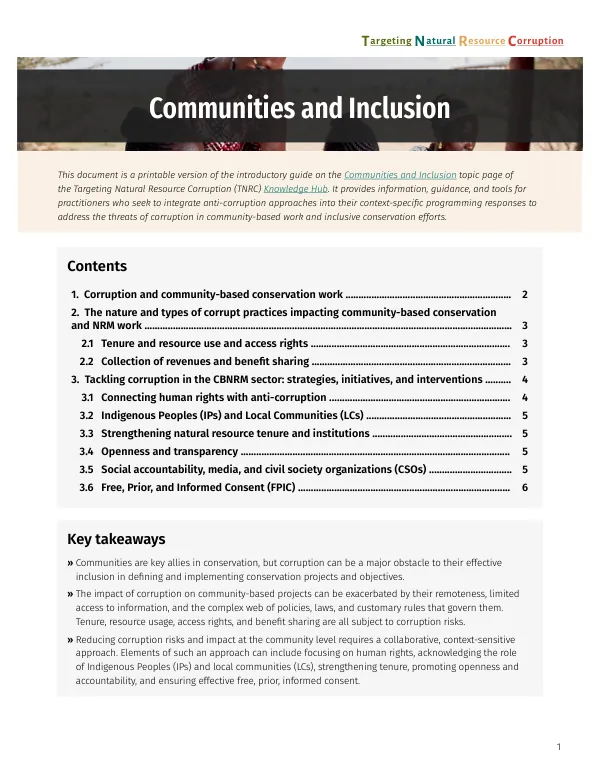
Corruption can be a major obstacle to community-based conservation work, particularly in remote areas with limited access to information and complex governance structures. Tenure, resource usage, access rights, and benefit sharing are all subject to corruption risks. Corruption can occur in various forms, including influence trading, bribery, and public officials taking bribes to undervalue land or speed up environmental and social impact assessments. Women are often particularly vulnerable to certain forms of land corruption due to customary patriarchal norms and other factors. Corrupt practices can also occur in enforcing rights to participation in resource decisions, including deliberately excluding individuals, communities, and other resource users from participating in the decision-making process of conservation projects. The collection of revenues from natural resource use and equitable sharing of benefits with community rights holders can be particularly vulnerable to corruption. This is especially true where there is uncertainty around the specific rights of community members to benefits, low transparency and oversight, and weak enforcement of local accountability mechanisms. Forms of corruption include diversion of conservation funds for private use, systemic bribery, and rent-seeking in natural resource contracts. Reducing corruption risks and impact at the community level requires a collaborative, context-sensitive approach. Elements of such an approach can include focusing on human rights, acknowledging the role of Indigenous Peoples and local communities, strengthening tenure, promoting openness and accountability, and ensuring effective free, prior, informed consent. This approach can help address the underlying structural problems that lead to corruption, environmental crime, and biodiversity loss by providing appropriate conditions for the involvement and participation of local communities in conservation decision-making and building trust and legitimacy of natural resource management initiatives at the local level. Community-Based Natural Resources Management (CBNRM) approaches can help address the underlying structural problems that lead to corruption, environmental crime, and biodiversity loss by providing appropriate conditions for the involvement and participation of local communities in conservation decision-making and building trust and legitimacy of natural resource management initiatives at the local level. However, corruption can be a real barrier to sound, effective CBNRM. Local leaders may lack commitment to address environmental crime due to corruption and collusion with politicians and criminals, or corruption at higher levels may effectively take power out of local hands and preempt local decision-making. Understanding and addressing corruption risks related to CBNRM is fundamental to reducing the threats that corruption poses to conservation and natural resource management objectives and ensuring meaningful participation from Indigenous Peoples, local communities, and/or community-based organizations. A collaborative, context-sensitive approach is necessary to reduce corruption risks and impact at the community level, focusing on human rights, acknowledging the role of Indigenous Peoples and local communities, strengthening tenure, promoting openness and accountability, and ensuring effective free, prior, informed consent.
Related documents