CIMMYT
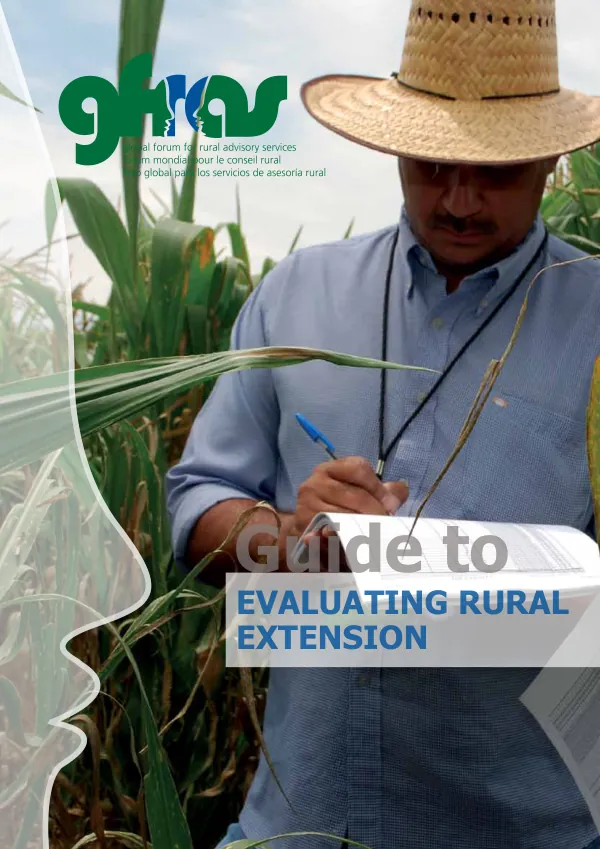
Guide to Evaluating Rural Extension
The Global Forum for Rural Advisory Services (GFRAS) has developed a guide to evaluating rural extension, with the aim of supporting those involved in extension evaluation to conduct more comprehensive, rigorous, credible, and useful evaluations.
2012 · 56 pages
Sign in to readA free account is required to download.
Abstract
The guide is intended primarily for four sets of evaluation stakeholders: those commissioning and managing evaluations, professional evaluators and staff responsible for monitoring systems, professionals involved in training and educating evaluators, and researchers looking for ways to synergise their efforts with evaluation initiatives. The guide begins by outlining what 'extension' means today and why it is especially important to use evaluation to improve these services. Extension refers to the provision of information, knowledge, and advice to farmers and other actors in rural development, with the goal of improving their livelihoods and natural resource management. The scope of the guide is broad, encompassing a range of extension services that may be provided by public sector agencies, private firms, research institutions, and civil society organizations. The guide identifies five key areas to extension reform, which are analyzed with respect to how to evaluate the appropriateness and effectiveness of extension interventions within a given policy and socio-economic context. These areas include focusing on best-fit approaches, embracing pluralism, increasing accountability to rural clients, developing human resources, and ensuring sustainability. The guide provides a normative framework for evaluation of extension, structured in accordance with these five key areas. It offers a menu of approaches, evaluation questions, conceptual frameworks, and signposts for issues that are particularly relevant when monitoring and evaluating extension. The criteria for what is assumed to be 'good extension' in this guide are strongly linked to areas that GFRAS has identified as important for the development of effective and sustainable extension systems. The guide emphasizes the importance of recognizing the diversity of extension systems, which are driven by a mix of goals of farmers, governments, private firms, researchers, and others in the innovation system and within broader rural development interventions. It also highlights the need to evaluate the appropriateness and effectiveness of extension interventions within a given policy and socio-economic context. The guide is intended to support readers in understanding different types of evaluation, making decisions on what is most appropriate for their circumstances, and accessing further sources of theoretical and practical information. It is expected to be useful for a broad range of stakeholders, including policy makers in ministries of agriculture, environment, and finance, and international development agencies. The guide's approach to evaluation is centered on the idea of 'best-fit' approaches, which involve identifying the most suitable extension services and interventions for a given context. It also emphasizes the importance of embracing pluralism, increasing accountability to rural clients, developing human resources, and ensuring sustainability. The guide provides a range of tools and resources to support the evaluation of extension, including evaluation questions, conceptual frameworks, and signposts for issues that are particularly relevant when monitoring and evaluating extension. It also offers guidance on how to choose evaluation approaches and methods, and how to evaluate the sustainability of extension interventions. Overall, the guide aims to provide a comprehensive and practical resource for those involved in evaluating rural extension, with the goal of improving the effectiveness and sustainability of extension services and interventions.