USAID DEC
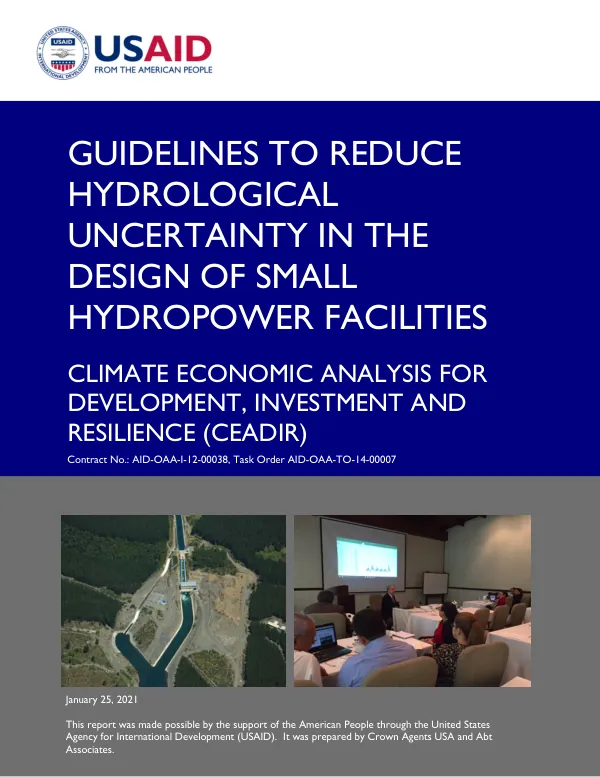
Guidelines to Reduce Hydrological Uncertainty in the Design of Small Hydropower Facilities
Sign inABT ASSOCIATES
Guidelines to Reduce Hydrological Uncertainty in the Design of Small Hydropower Facilities
Small hydropower facilities are a crucial source of renewable energy, particularly in developing countries.
2021 · 43 pages
Sign in to readA free account is required to download.
Abstract
The installed and potential capacity for small hydropower, defined as facilities with a capacity of 10 MW or less, varies by continent and region. In South America, for example, the installed capacity is approximately 2.5 GW, while in Africa, it is around 1.5 GW. The design of small hydropower facilities is often hampered by hydrological uncertainty, which can lead to inaccurate estimates of streamflow and sediment loads. This, in turn, can result in inadequate infrastructure and reduced project efficiency. To mitigate this issue, the Climate Economic Analysis for Development, Investment, and Resilience (CEADIR) project has developed guidelines to reduce hydrological uncertainty in the design of small hydropower facilities. The guidelines emphasize the importance of geographic information, including digital elevation models and land use and soil maps. These data are essential for estimating streamflow and sediment loads, as well as identifying potential areas of hydrological uncertainty. The guidelines also recommend the use of advanced hydrologic modeling systems, such as the Hydrologic Engineering Center Hydrologic Modeling System (HEC-HMS), to simulate streamflow and sediment transport. Estimating the design flow is a critical component of small hydropower facility design. The guidelines provide a step-by-step approach for estimating streamflow series at the site, calculating the design flow for small hydropower, and estimating design hydrographs for extreme floods. The guidelines also discuss the importance of sediment loads and provide a method for estimating sediment loads using a sediment rating curve. Sources of uncertainty in hydrological studies are also identified and discussed in the guidelines. These include uncertainty in precipitation data, soil moisture, and land use changes. The guidelines provide recommendations for reducing these sources of uncertainty, including the use of advanced remote sensing technologies, such as LIDAR and ASTER, to improve precipitation and soil moisture estimates. The guidelines are intended to provide a comprehensive framework for reducing hydrological uncertainty in the design of small hydropower facilities. By following these guidelines, project developers and engineers can improve the accuracy of their estimates and reduce the risk of project failure. The guidelines are also expected to contribute to the development of more efficient and sustainable small hydropower facilities, which can help meet the growing demand for renewable energy in developing countries.