ABT ASSOCIATES
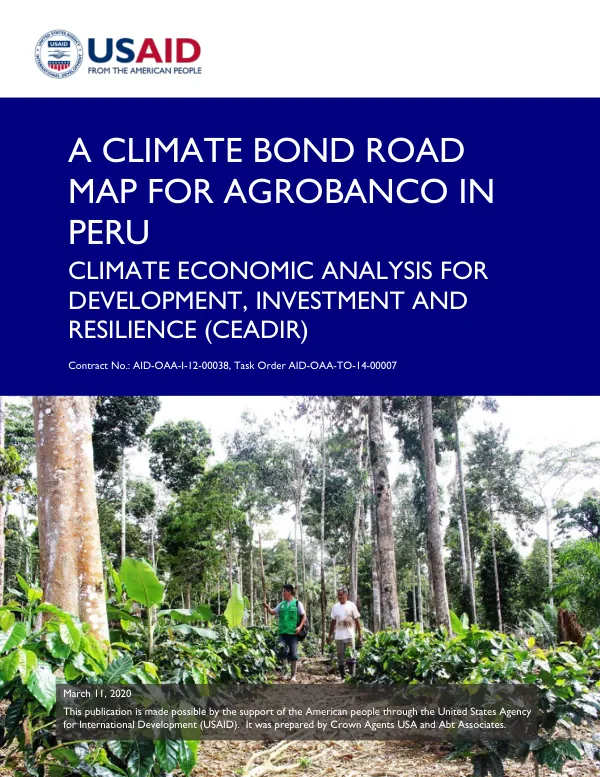
A Climate Bond Road Map for AgroBanco in Peru
Agriculture, forestry, and other land uses have been responsible for over half of the country's greenhouse emissions.
2020 · 42 pages
Sign in to readA free account is required to download.
Abstract
Forestry is one of the five pillars of the country's climate adaptation strategy. The Government of Peru recognized the importance of forests for indigenous populations, maintenance of ecosystem services, and reducing climate risks. Between 2001 and 2014, an average of 118,000 hectares of forest per year was converted to other land uses. The annual deforestation rate was 180,000 ha in 2014 and is projected to reach 275,000 ha by 2030. The Monitoring of the Andean Amazon Project (MAAP) used high-resolution satellite imagery to document six major drivers of deforestation and forest degradation. These drivers include small- and medium-scale agriculture, large-scale agriculture, cattle grazing, gold mining, illegal coca cultivation, and roads. MAAP concluded that small-scale agriculture and cattle grazing were the most important drivers of deforestation overall, but this varied by location. In Southern Peru, gold mining was a major driver of deforestation, while large-scale agriculture and construction of major new roads were more latent threats. In Central Peru, logging road construction was a major source of direct and indirect deforestation. Approximately 90 percent of deforestation in Peru has been due to agricultural expansion, including 75 percent from small-scale agriculture. If unsustainable agriculture, livestock, forestry, and aquaculture continue, an additional 7.3 million ha of forests could be lost by 2050. Agriculture has high economic importance in Peru, especially for palm oil, cocoa, rice, and coffee. As a result, it is essential for the country to adopt more sustainable agricultural production practices. New sources of financing are needed to scale up investment in sustainable agriculture and forestry and help small-scale producers adapt to current and future climate risks. Green bonds and climate bonds are among the possible solutions for scaling up these investments. A green bond is a tradeable debt security that finances investments with environmental benefits. Climate bonds, on the other hand, are specifically designed to address climate change mitigation and adaptation. The Climate Bonds Initiative (CBI) has established certification criteria for climate bonds, which include requirements for transparency, reporting, and environmental impact. AgroBanco, a Peruvian bank, is interested in issuing a climate bond to finance sustainable agriculture and forestry projects. The bank has identified the need for a climate bond road map to guide the issuance process. The road map will outline the steps necessary to issue a climate bond, including market analysis, design of a climate bond framework, preparation of the offer and issuance, and post-issuance activities. The road map will also provide guidance on the use of proceeds, default recourse, and environmental, social, and governance (ESG) considerations. The Climate Economic Analysis for Development, Investment, and Resilience (CEADIR) Activity has been working with AgroBanco to develop the climate bond road map. The CEADIR Activity has provided technical and editorial guidance to the authors of the road map, which includes Michele Laird and Eric Hyman. The road map is expected to be a valuable resource for AgroBanco and other financial institutions in Peru looking to issue climate bonds. It will provide a clear and concise guide to the climate bond issuance process and help to promote sustainable agriculture and forestry practices in the country.