DELOITTE CONSULTING, LLP
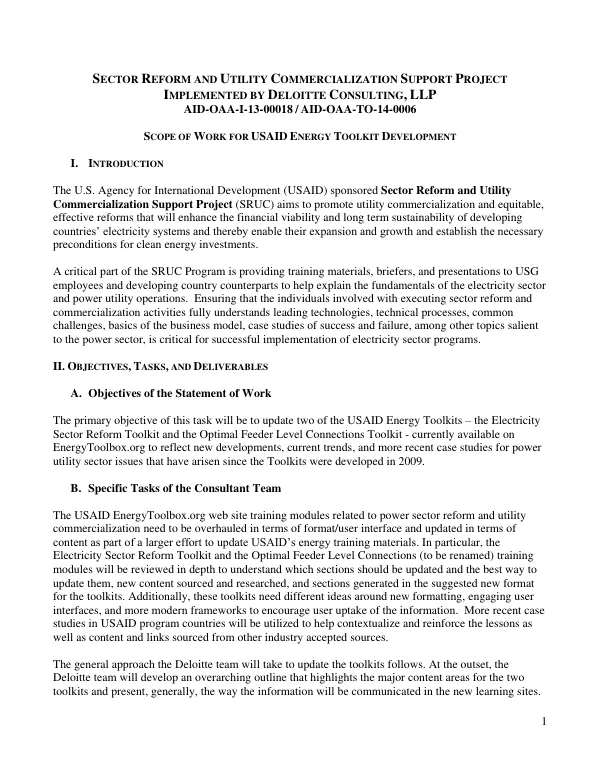
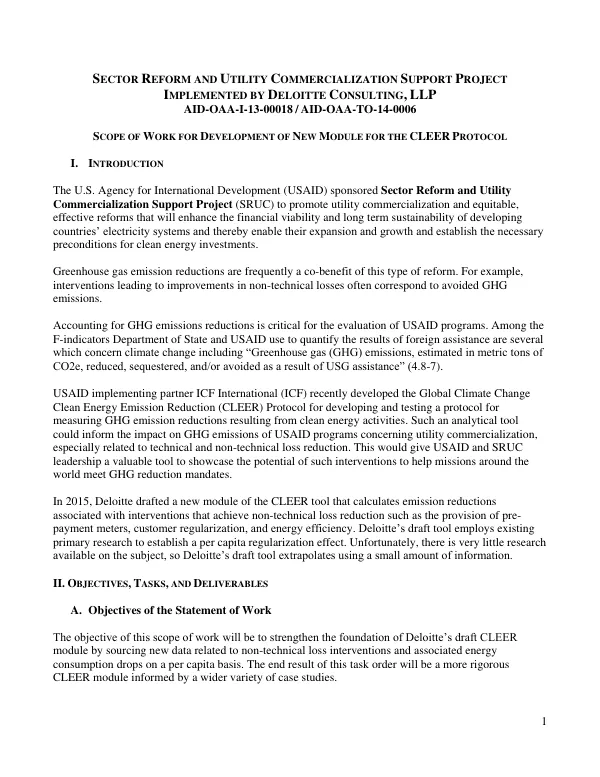
Sector Reform and Utility Commercialization Support Project
The Sector Reform and Utility Commercialization Support Project was implemented by Deloitte Consulting, LLP, with funding from the U.S.
2018 · 3 pages
Sign in to readA free account is required to download.
Abstract
Agency for International Development (USAID). The project aimed to promote utility commercialization and equitable, effective reforms that would enhance the financial viability and long-term sustainability of developing countries' electricity systems. This would enable their expansion and growth, establish the necessary preconditions for clean energy investments, and frequently result in greenhouse gas emission reductions. The project focused on utility commercialization and reform activities, particularly related to technical and non-technical loss reduction. Non-technical losses refer to the reduction in electricity consumption due to factors such as theft, metering inaccuracies, and billing errors. Accounting for greenhouse gas emissions reductions is critical for the evaluation of USAID programs, and the project aimed to provide a valuable tool to quantify these reductions. The primary objective of the task was to provide technical input to ICF International (ICF) on the development of a new CLEER module to model the greenhouse gas emission impacts of non-technical loss reduction. This would assist USAID with better articulating greenhouse gas savings associated with utility commercialization and reform activities. The Deloitte team would start by examining other modules within the CLEER tool and comparable tools such as RETScreen and System Advisor Model, and then incorporate leading practices from these modeling environments into the line loss reduction module for both technical and non-technical losses. To build out a methodology for a non-technical loss module, Deloitte would develop a list of questions for the Excel methodology and corresponding data sources to gauge the size of non-technical loss reduction programs' power reduction impact on the electricity system. The team would consider a panoply of potential non-technical loss interventions, document how they are processed by the tool, and propose enhancements to the tool to better accommodate different types of interventions. Specific interventions that would be examined include different types of theft-reduction technologies, policy and management approaches to loss reduction, greenfield construction of efficient technology, and advanced metering. The Deloitte team would work with the ICF team to develop a Non-Technical Line Loss Reduction Methodology, similar to the other technology-specific modules. ICF would then incorporate that methodology into a CLEER module calculator. Thereafter, Deloitte and ICF staff would train USAID and SRUC leadership on the ability of this tool to quantify greenhouse gas emissions reductions associated with utility reform initiatives. Through a simple briefing document and an informal hands-on training, staff would show USAID and SRUC leadership how the tool can be used to illustrate the relationship between utility reform and greenhouse gas emissions reduction. The consultancy would be completed in approximately 15 business days following client approval of the Statement of Work. The projected level of effort assumes timely cooperation from ICF and other stakeholders. The total projected level of effort is 18 days, with XXX serving as the Chief of Party, XXX as the Utility Commercialization Specialist, XXX as the GHG Modeling Specialist, and XXX as the Technical & Engagement Coordinator.