USAID FAMINE EARLY WARNING SYSTEMS NETWORK
GUINEA Desk Review
The Republic of Guinea is a West African country with a total land area of 245,857 km2.
2013 · 16 pages
Sign in to readA free account is required to download.
Abstract
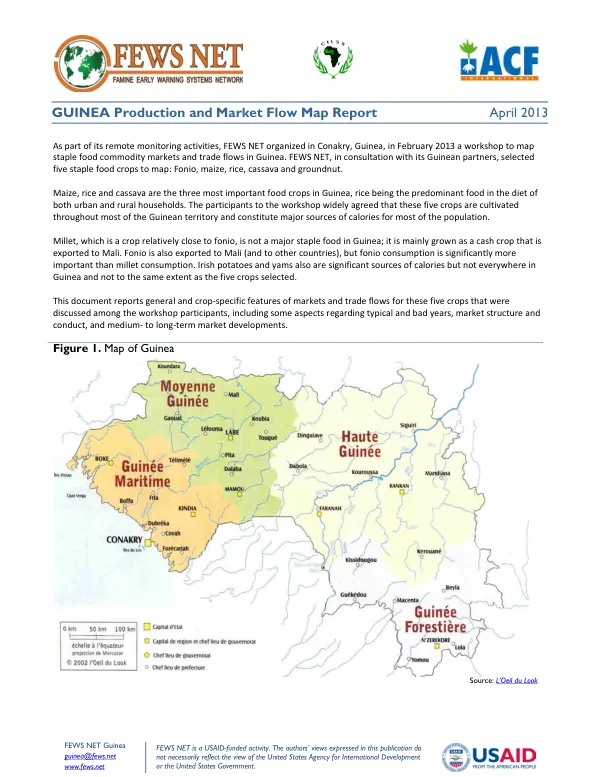
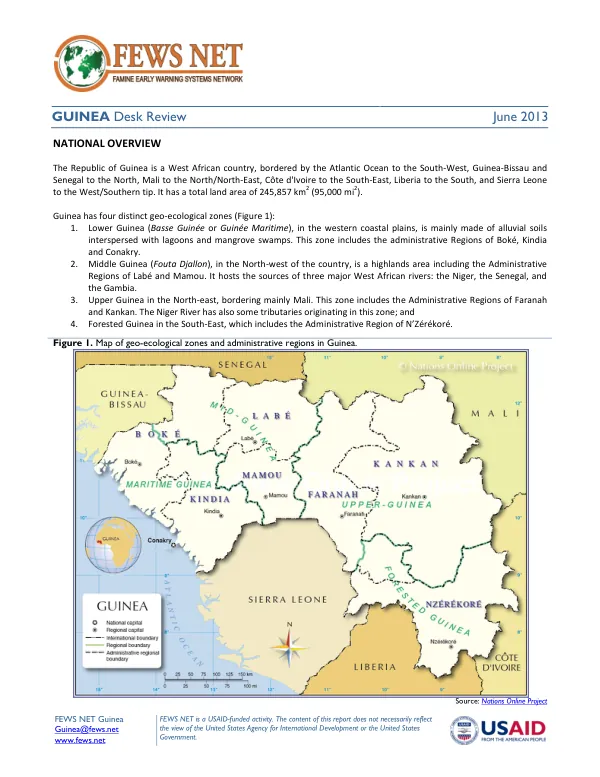
The country is bordered by the Atlantic Ocean to the South-West, Guinea-Bissau and Senegal to the North, Mali to the North/North-East, Côte d'Ivoire to the South-East, Liberia to the South, and Sierra Leone to the West/Southern tip. Guinea has four distinct geo-ecological zones, including Lower Guinea, Middle Guinea, Upper Guinea, and Forested Guinea. The country's climate is tropical, with a long rainy season of eight months and a relatively uniform annual temperature of 23 to 29°C. Annual rainfall varies between 1,500 and 4,500 mm, with Upper Guinea experiencing a shorter rainy season and a longer dry season. Guinea has an abundant estimated 226 km3 of renewable water resources, earning it the title of the water tower of West Africa. The country also has about 6.2 million hectares of arable land and abundant forest resources. Guinea has rich and diversified mineral deposits, including bauxite, gold, diamond, cobalt, iron-ore, oil, and uranium. The mining sector represents 26 percent of Guinea's GDP and accounts for 72 percent of its exports. The country's population is approximately 11 million inhabitants, with about 70 percent living in rural areas and 30 percent in urban areas. The capital and largest city, Conakry, has a population estimated at 2.2 million in 2012. The agricultural sector contributes 22.1 percent to Guinea's GDP, with the majority of the population engaged in subsistence farming on small plots. Despite its potential, Guinea does not cover its food needs, particularly in rice, due to the preponderance of subsistence agriculture. The country imports about 10 percent of its cereal needs and up to 25 percent of total food needs, with rice, sugar, wheat, maize, vegetable oil, and maize constituting the largest food imports by volume. Guinea's reliance on food imports renders it vulnerable to international price fluctuations, such as the 2008 global food price crisis. The country produces a variety of food and cash crops using many different production systems, with the three main food crops grown in Guinea being rice, cassava, and groundnuts. The Government estimates that the area suitable for agriculture is about 6 million hectares, of which less than 2 million hectares are under cultivation. The country's poverty rate is high, with 53 percent of the population living below the poverty line in 2013, defined as the equivalent of 196 USD/person/year. Poverty is primarily a rural problem, with about 63 percent of people in rural areas living in poverty compared to 30 percent in urban areas. The social conditions of Guineans have been aggravated by persistent internal social and political problems, as well as refugee movements from neighboring countries. Guinea is currently in transition to democracy after the first presidential elections of 2010, with elections for the currently dissolved legislative body delayed. The country has been recommended to receive significant debt relief under the Enhanced Initiative for Heavily Indebted Poor Countries and the Multilateral Debt Relief Initiative.