USAID FAMINE EARLY WARNING SYSTEMS NETWORK
Guinea Production and Market Flow Map Report
The agricultural sector in Guinea is a significant contributor to the country's economy and food security.
2013 · 13 pages
Sign in to readA free account is required to download.
Abstract
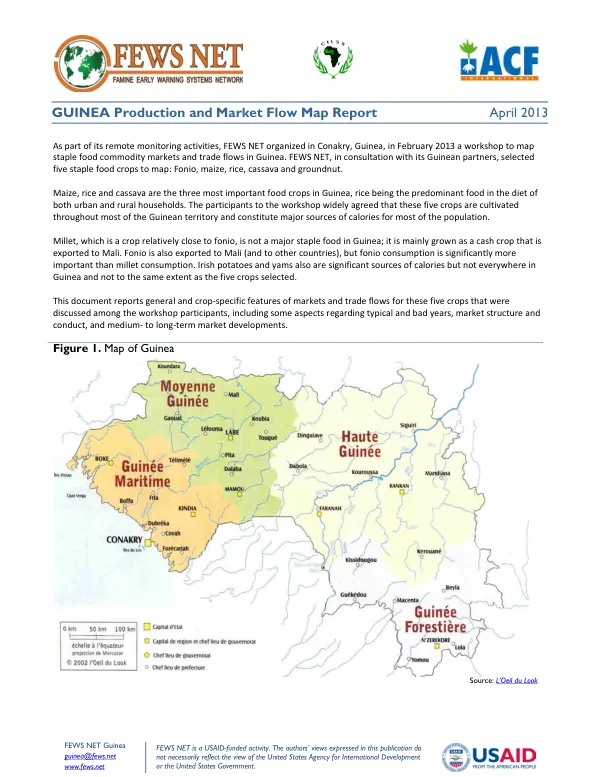
Staple food crops such as fonio, maize, rice, cassava, and groundnut are cultivated throughout most of the Guinean territory and constitute major sources of calories for the population. These crops are widely consumed in both urban and rural households, with rice being the predominant food in the diet. Maize, rice, and cassava are the three most important food crops in Guinea, with rice being the main staple food of Guinean households. The major producing areas for these crops are in coastal Guinea, Moyenne Guinée, and southeastern Guinea. The major surpluses are in the eastern part of Guinée Forestière, a part of Haute Guinée bordering Mali, and the north of Moyenne Guinée. Major internal trade flows go from the surplus markets in the southeast westwards and northwards, with major flows from the producing areas of coastal Guinea to the deficit areas of Moyenne Guinée. Fonio is a major staple food for Guinean households, although it is neither produced nor consumed in as large quantities as in the rest of the country in southeastern Guinea. Major fonio surplus areas are in Moyenne Guinée and Haute Guinée, while major deficit zones are in southeastern Guinea and in and around Conakry. Major internal trade flows go from Kankan to northeastern and southeastern Guinea, from Labé to Mamou and then to Conakry, and from Labé to the north of Moyenne Guinée. The market structure and conduct in Guinea are characterized by private markets that developed relatively late in the 1990s after an extended period of post-colonial, state-controlled agricultural marketing. The provision of transportation services is insufficient, and the other types of infrastructure supporting agricultural markets are also underdeveloped. As a result, local food products may be less competitive on markets compared to imported products, further slowing the development of local value chains. Supply chains for local food products are primarily small-scale, involving smallholder producers and small-scale traders, particularly women. The main market participants intervening at different stages of the supply chain are rural collectors buying crops from producers, urban collectors bringing crops to small urban centers, wholesale traders buying large volumes in villages and small urban centers and supplying wholesale markets in large urban centers, and retailers. In Guinea, the roles of assembly markets and wholesale markets in and around producing areas are somewhat intertwined. Conakry, the capital city, hosts nearly half of the urban population in Guinea and constitutes the largest consumption market. Other large urban centers/consumption markets are Kankan, Labé, and N'Zérékoré.