USAID FAMINE EARLY WARNING SYSTEMS NETWORK
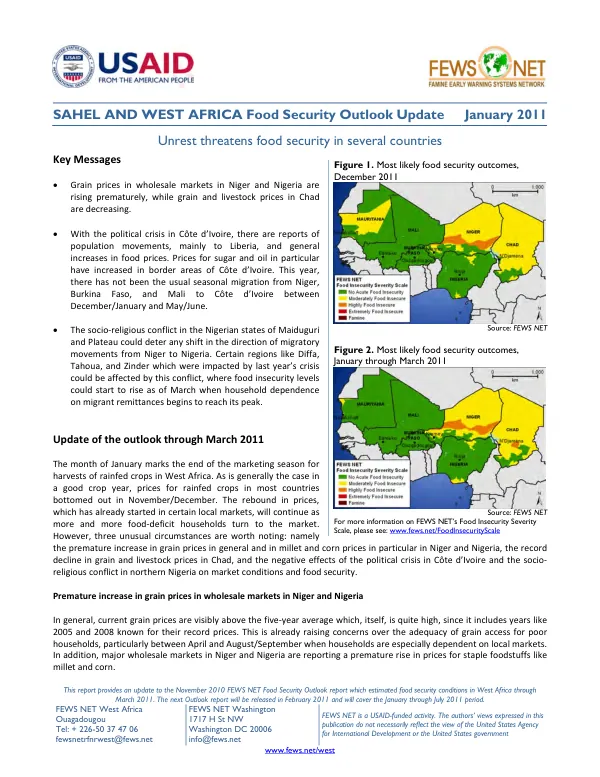
Sahel and West Africa Food Security Outlook Update
Food security conditions in West Africa and the Sahel are generally considered average to good due to good harvests for the 2010/11 growing season.
2011 · 2 pages
Sign in to readA free account is required to download.
Abstract
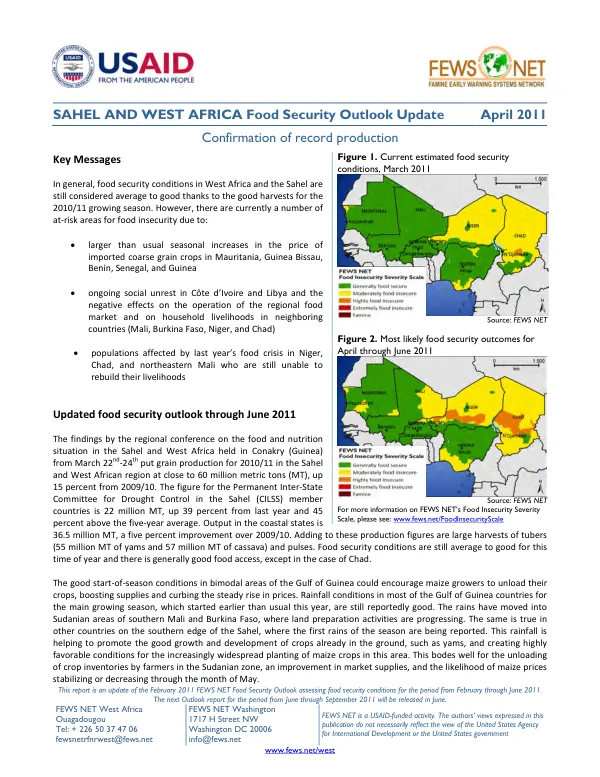
However, several at-risk areas for food insecurity have been identified. These areas include Mauritania, Guinea-Bissau, Benin, Senegal, and Senegal, where larger-than-usual seasonal increases in the price of imported coarse grain imports have been observed. Additionally, ongoing unrest in Côte d'Ivoire and Libya has negatively impacted the regional food market and household livelihoods in neighboring countries, including Mali, Burkina Faso, Niger, and Chad. The regional conference on the food and nutrition situation in the Sahel and West Africa, held in Conakry, Guinea, from March 22nd-24th, reported grain production for 2010/11 in the Sahel and West African region at close to 60 million metric tons, a 15 percent increase from 2009/10. The Permanent Inter-State Committee for Drought Control in the Sahel (CILSS) member countries reported a 22 million metric ton output, a 39 percent increase from the previous year and 45 percent above the five-year average. Output in the coastal states was 36.5 million metric tons, a five percent improvement from 2009/10. The good start-of-season conditions in bimodal areas of the Gulf of Guinea could encourage maize growers to sell their crops, leading to increased supplies and a decrease in prices. Rainfall conditions in most of the Gulf of Guinea countries for the main growing season, which started earlier than usual this year, are still reportedly good. The rains have moved into Sudanian areas of southern Burkina Faso and Burkina Faso, where land preparation activities are underway. The same is true in other countries on the Sahel's southern edge, where the first rains of the season are being reported. This bodes well for the growth and development of crops already in the field, such as yams, and the widespread planting of maize crops in this area. The widespread growth and development of crops in the region, particularly in the Sudanian zone, is expected to lead to an improvement in market supplies and a decrease in maize prices. However, supplies of grain and other crops are tightening due to the winding up of marketing activities by farmers and the end of off-season crops. Market supplies are being sustained by traders and imports from the international market, whose future is uncertain. Despite the steady downward movement in rice prices on international export markets, concerns about the precarious state of equilibrium on the international market, high transportation costs, and fluctuations in exchange rates for the region's main currency are still present. The widespread depletion of household food reserves at the local level is a common phenomenon in April, with food demand from deficit households putting pressure on local markets. This could lead to increased prices over the next few months, making it difficult for households with no food reserves to maintain access to staple foods. Côte d'Ivoire's food security situation is escalating, with paralyzed markets, depleted market inventories and household reserves, community assistance reaching its breaking point, soaring prices, and a shortage of food and water.
Related documents